What are God’s goals for true fasting? What promises does God give to those who fulfill a true fast? If “exploitation” describes worker injustice, what word would you use to describe worker justice? How do you think true fasting would change the conditions of the workplace and the social status of workers? During this Lenten Compact, what is one change would you like to see in the way workers are treated in your community? Your workplace?
Author: Bruce Ray
Choose the Cross, Not the Arches
Starting today–Ash Wednesday–we’re “Not Lovin’ It”. We’re embarking on our Fast Food Fast for Worker Justice as a way to show solidarity with all low-wage workers throughout the global economy. We’re giving up Big Macs and Big Gulps and Blizzards and Lattes. But we’re not just giving up Fast Food; we’re giving up an economic system that chews up people and spits them out all in the quest for greater and greater profit–the idol of the marketplace.
Every day during Lent, a devotional will be posted to help you engage the issue of worker justice. You can share comments, interact with others who are on the Fast Food Fast. Together, we will learn what God has to say about work and wages and a different economy. And we will move toward God’s vision of ‘shalom’ and justice. Link HERE for today’s devotional.
Day 01 Devotional & Discussion – February 18, 2015
In Isaiah’s day, there was outward evidence of spiritual desire, yet the people’s religious activity was not matched with just social structures—specifically, the way workers were treated. Do you see a similar disconnect today? Think of an example. The Hebrew word translated “exploit” in verse 3 (NIV) can also mean “exert pressure upon”, “drive”, and “oppress.” Have you ever felt exploited? When? Think of an example of how workers today are being exploited.
It’s Shrove Tuesday! Meet Nancy Salgado
Lent begins tomorrow, which makes this SHROVE TUESDAY! Or if you prefer, Mardi Gras or Fasnacht.
So, while you’re eating your pancakes, paczkis, and fatty meat and peas, take a moment to meet Nancy Salgado, a Logan Square fast food worker who was featured in The Reader’s ‘This Week’s Chicagoan’ column. Read her story HERE.
On Sunday, February 22, you’ll be able to meet Nancy at Kimball Avenue Church, 3429 W. Diversey Ave. (2nd Fl) at 10:00 am. She will be joined by Luke Sullivan, an organizer with Arise Chicago, a faith-based organization that is addressing issues of worker injustice. With their help, we will begin to look at the issues facing low-wage workers everywhere. Be sure to read the comments posted below Nancy’s story. This will give you a sense of the public opinion about raising the minimum wage. As you read them, ask yourself how Jesus might comment. I’m sure we’ll talk about it when we meet Nancy on Sunday.
Today, Everybody Works!
Sermon text from February 15, 2015, on Matthew 20:1-16
Bruce Ray, Pastor of Kimball Avenue Church, Chicago
Ched Myers in his book, Say To This Mountain, writes, “Parables have typically been preached in North American churches as ‘earthly stories with heavenly meanings.’ That, however, is exactly what they are not. (my emphasis) Rather, Jesus is describing the sovereignty of God in the most concrete possible terms, using images any illiterate peasant could understand. The genius of parables is that they offer recognizable scenarios, drawing listeners in, then throw surprise twists in order to challenge listeners’ assumptions about what is possible. Jesus no doubt struggled to explain his vision because it was so much at odds with the prevailing order and thus with the expectations of his audience.” (Myers, Ched; Dennis, Marie; Nangle, Joseph; Moe-Lobeda, Cynthia; Taylor, Stuart. “Say to This Mountain”: Mark’s Story of Discipleship (Kindle Locations 841-845). Orbis Books. Kindle Edition.)
Jesus’ parables about the kingdom of heaven reveal the ordering of all of life by the reign of God. Such is the parable of the Landowner and the workers in his vineyard recorded in Matthew 20:1-16. It is a story of labor relations, work, and wages in the kingdom of heaven. And it is a story of the values that are fundamental to God’s re-ordering of life. And it is a story that reveals the answer to our prayer, “your kingdom come; your will be done on earth as it is in heaven” as it relates to the structures of work and the economy.
Read the entire sermon text here…. 021515 Sermon
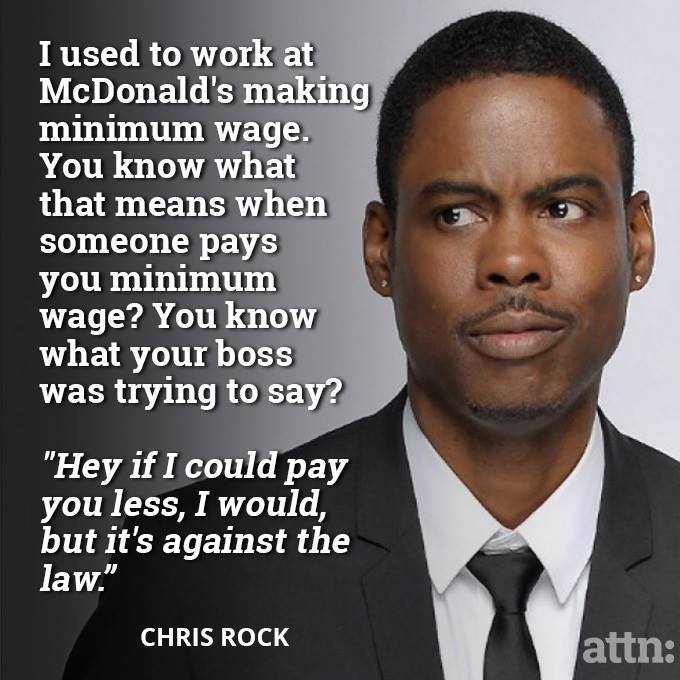
Chris Rock on the Minimum Wage
Learn more about our “Fast Food Fast for Worker Justice” by linking to the 2015 Lenten Compact page.
2015 Compact
 NOT LOVIN’ IT
Fast Food Fast for Worker Justice
A Communal Fast
Lent is often considered a personal time to give up something we like, focus ourselves on God, and reflect on the idols that we have been told we cannot live without. At our church, we invite people to participate in a communal fast—called a Lenten Compact—that focuses us not only on our relationship to God, but also on our relationship to our neighbors—especially our brothers and sisters who are “bound in chains of injustice.” We are calling our church to a true fast—one that is not just the act of denying oneself of something because that is not enough—but a fast that moves us toward justice and reconciliation.
In Isaiah 58, the Lord condemns those who fast while exploiting their workers and makes clear what a true fast should accomplish:
“Is not this the kind of fasting I have chosen: to loose the chains of injustice and untie the cords of the yoke, to set the oppressed free and break every yoke? Is it not to share your food with the hungry and to provide the poor wanderer with shelter— when you see the naked, to clothe him, and not to turn away from your own flesh and blood?”
Why a “Compact” for Worker Justice?
The Bible is clear: “The laborer deserves to be paid.” (1 Timothy 5:18 NRSV) Yet, workers around the world are suffering. Workers are chained to their machines in China. Children are lured into slavery by the cocoa plantations in West Africa. Workers pay off debts through labor for generations in India. And things are not much better in the United States, where it seems we on a race to the bottom.
Since the Great Recession, 75% of the jobs that have been created are low wage service jobs—not the middle wage jobs that were lost. Low-wage workers are especially concentrated in the food service and retails sectors. Income inequality—the gap between the rich and poor—is at its highest rate since 1927. Executive pay and bonuses have continued to increase while the wages of most Americans has stagnated or declined. In fact, current CEO pay is 774 times a minimum wage worker. To put that in perspective, it would take a typical McDonald’s front line employee 777 years to make what McDonald’s CEO, Don Thompson, made in 2013. And the future of work is not bright for most people. Human labor is being replaced with robotics at an alarming rate. Through the extensive use of robots in its distribution system, online giant, Amazon, effectively eliminated 540,000 jobs. What will happen to all the displaced workers?
McDonald’s, the largest fast food chain, had profits of $4.76 billion in 2014. Yet those on the front lines of their stores make just over minimum wage–$8.25 in Illinois and less in many other states. We often picture McDonald’s employees to be high school students, yet the average age of McDonald’s employees is 28 and 78% of the employees (mostly women) are the main wage earners in their families. Additionally, because of low wages, 52 percent of employees are enrolled in one or more assistance programs—like food stamps and Medicaid—costing taxpayers about $7 billion a year! Studies show that a person in Chicago must earn $20.86 an hour to support a family’s basic living expenses.
Walmart, the largest retailer in America, claims that the average full time worker receives $12.78 an hour. They also claim that over half of their employees make more than $10.00 an hour. That means that many full time employees make less than $10.00 an hour. They also don’t tell you that 46% of their workforce of over a million people work part time and receive no benefits. Yet, four members of the Walton family, principle owners of Walmart , are among the 10 wealthiest people in the US with a combined net worth of over 95 BILLION dollars in 2012. In the meantime, a Walmart in Canton, OH, has held a holiday food drive to benefit store employees in need. On Black Friday 2014, many Walmart employees staged a strike asking for better pay and access to full time hours. Some of those employees were fired by their managers even though it is against Walmart policy. Those managers have not been disciplined.
Many workers are experiencing “wage theft” which occurs when workers are denied the legally required minimum wage or overtime rate or when they work off the clock without pay, are paid late, or are not paid all of the money or benefits they are owed. For example, in Illinois, tipped employees must earn at least a combined $8.25 per hour between hourly wages and tips. In 2012, among car wash workers (considered tipped employees), over 75% of workers did not earn the minimum wage of $8.25 per hour, and 13% earned less than $2.00 per hour!
In Washington State, 200 migrant farmworker families at Sakuma Brothers Farms have been organizing to fight for better wages, housing conditions and work conditions. The workers want a fair contract with fair wages and clear protection of their rights. So far, they have been met with harassment and threats. Supporters of the migrant workers have asked for a boycott of Driscoll’s products (varieties of fresh berries) until Sakuma Brothers agrees to a contract.
We do not believe that an economic system that is built upon substandard wages and mistreatment of workers mirrors God’s kingdom values of human dignity, neighbor love, and shared abundance.
WEDNESDAY, FEBRUARY 18 THROUGH SATURDAY, APRIL 4
“Choose the Cross, not the Arches”
To move ourselves and our community toward justice, we ask all participants to take the following actions:
Fast from ALL fast food chains to show solidarity with all low-wage workers.
Participate in efforts to eliminate wage theft and raise the minimum wage.
Why?
Fast food is a multi-billion dollar industry. People spend more in fast food outlets than on movies, books, magazines and newspapers combined. Yet, most of the workers in the industry are paid minimum wage. Every time we purchase food from a fast food outlet, we put money into the pockets of those who profit at the expense of people. By fasting from fast food, we draw attention to the need for increasing the minimum wage and giving dignity and value to all work. In Chicago, fast food workers are fighting for a $15 an hour wage. We can also use our resources to pursue justice in the workplace by eating where employees are paid fair wages.
SUPER-SIZE Your Lenten Compact
We encourage you to take these additional action steps to bring justice to the workplace:
- Work the Word
Each day, a Scripture related to worker justice, work, wages, and treatment of workers along with a question or two to help you reflect on the passage will posted on a separate page on this blog . You can make comments, share stories and interact with others about the daily Scripture.
- Get Educated
Throughout Lent, a list of books, articles, online blogs, documentaries and resources will be made available to help you understand the conditions of workers in the US and around the world and the issues related to wages, workers rights, and employment in the robotic age. Resources will be posted on the Compact blog.
- Participate in Discussion Groups and Palm Sunday
If you live in Chicago, we will join other Logan Square churches to talk about worker justice and take action in support of the Fight for $15. The first discussion will take place on Wednesday, February 25, at Nuestra Señora De Las Americas, 2900 W. Logan Blvd. The second discussion will be held on March 25, and Humboldt Park United Methodist Church. On Palm Sunday, churches will gather at the Logan Square Eagle to celebrate the just kingdom Jesus brings.
- Fast Add-ons
- Fast from Driscoll’s produce to support the migrant farmworkers at Sakuma Brothers Farm.
- Fast from Chocolate to draw attention to the use of child slaves at the cocoa plantations in West Africa.
- Fast from Walmart to support low-wage workers who want to organize a union to get a fair contract.
- Use your Resources to Support Worker Rights
there are some great organizations working locally and nationally on the issue of workplace justice such as Interfaith Worker Justice and Arise. We encourage you to support these or other organizations with the money you have saved during the Fast Food Fast.
Finally, we encourage you to share this Compact with your network of friends and family. Consider posting a link on your Facebook page to the Compact blog or emailing a copy of the Compact to your contacts.
While the Compact will end at Easter, it is our hope that “supporting worker justice” will become your ongoing Kingdom lifestyle
Lent Begins February 18, 2015
The Season of Lent will begin on Ash Wednesday, February 18. With the start of Lent, we invite you to consider participation in a ‘true fast’ through our annual Lenten Compact. God informed God’s people that the reason their fasting was ineffective was because while they fasted they continued to exploit their workers (Isaiah 58:3 NIV). A fast that truly honors God is a fast that results in the elimination of oppression and abuse (Isaiah 58:6-7). Today, workers are crying out about wage theft, unfair labor practices, unpaid overtime, unpaid sick time, and unlivable minimum wages. Around the globe, children are being lured into slavery and the poor are forced into unpaid servitude. We also are seeing unprecedented income inequality in the United States. These are not simply political issues or the ‘givens’ of capitalist economics. These are moral concerns that are addressed by God through the Law, the prophets and Jesus. Link to the 2015 Compact page to read all about this year’s Fast Food Fast for Worker Justice–a fast we’re calling, “Not Lovin’ It”
114 Years Old…and Counting
On January 10, 1901, a small group of believers met to officially form the Kimball Avenue United Evangelical Church. Within the year, the group purchased land at the corner of Kimball and Medill and built a small frame chapel for worship. A lot has changed in the past 114 years, but the church continues to bring good news to Logan Square and beyond. Happy Birthday, Kimball Avenue Church!
Faith in Action Assembly
Each year on Martin Luther King, Jr’s birthday, Community Renewal Society organizes a Faith in Action Assembly. This year, the event will feature a mayoral candidate forum as well as calls to action to challenge the criminal (in)justice system in Cook County. The event will be held at Liberty Baptist Church, 4849 S. King Dr. If you would like to participate, please contact the church. For more information about the event, see the flyer.
 Tongue on Fire