Finding Peace in Anxious Times

I haven’t posted for over a week due to being out of the country. While I was away, I had enough access to the news from the US (tariffs, deportations, market collapse, etc), that I actually had “anxiety dreams”–something I had not experienced in years. I dreamt that I had been arrested for my blog posts. I dreamt that I wasn’t able to get back into the United States. I dreamt that the dollar was worthless.

It happened several nights in a row. And each morning I would awake, wondering if I would return to the same United States that I had left just a week before. The news cycle indicated that it was indeed different–and not in a good way.

I shared my dreams with my wife, who wisely reminded me that I needed to stay focused on God’s word and not on the circumstances that were out of my control. She has been using Psalm 90:1-2 as her daily focus and suggested that I pray that God would give me a verse as well. I did; and God did.

The next morning, I was awakened not with an anxiety dream, but with the voice of Jesus, repeating a phrase over and over. It was his last words to his disciples before leaving: “I am with you always, even to the end of the age.” (Matthew 28:20b) I’ve been repeating it daily ever since.

I was able to get back into the country. I haven’t been arrested (at least not yet). The shit show is still shitty as ever. (It’s the only word I have to describe it.) I have no illusions about the state of our democracy and the struggle we may face. But I think about those early church disciples and their “Roman Reality.” They faced opposition, and they experienced rejection. They were falsely accused; they were jailed; they were beaten; some even died. But they still spoke the truth and stood firm, and they even found joy together in the middle of their struggle, singing hymns in chains. I can imagine that they repeated Jesus’s final words as their morning mantra. And then they got out of bed and walked by faith.

Yes, Christ is with us. Always. Even to the end of the age. Yes. This age will end, and Christ will still be with us. Always. No matter what. Always.

(S)heroes of the Faith

If you’ve never heard of Rev. Pauli Murray and their story of faith-rooted activism, you’re not alone.

However, their story is in danger of being completely erased by the National Park Service in compliance with this administration’s order to end all references to DEI.

Learn about Rev Murray in this article published by Sojourners. https://sojo.net/articles/news/trump-administration-erases-page-honoring-trailblazing-priest-lawyer-and-activist

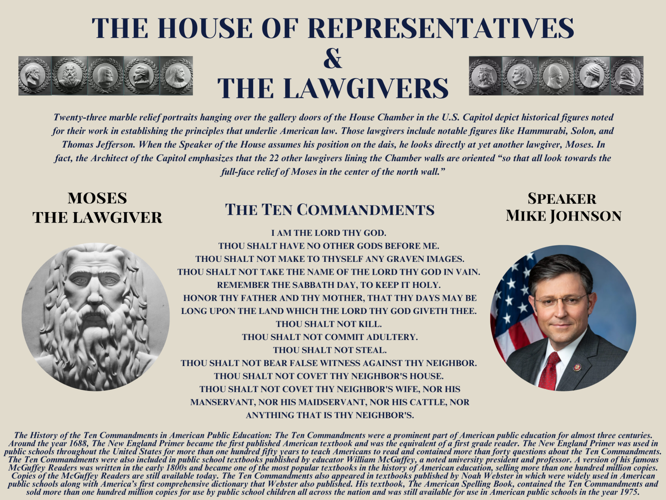
Should Schools Post the Ten Commandments?

On January 1, 2025, a new Louisiana law went into effect that requires all public schools to display a poster of the Ten Commandments in every classroom. Five school districts challenged the new law in U.S. District Court last Fall after Governor Jeff Landry signed the bill. The judge ruled that the law was unconstitutional, but the State of Louisiana has appealed the decision to a higher court. In the meantime, the State has said that the lower court’s ruling only applies to the 5 districts that brought the suit and that the other 67 districts in the State must comply with the law. According to the Associated Press, there is no evidence that any public school has put up the posters to date due to all the confusion.

Back in 1980, the Supreme Court heard the case of “Stone vs. Graham.” The State of Kentucky had passed a law similar to the new Louisiana law that required every school post the Ten Commandments. The justices ruled that the Kentucky law violated the “establishment clause” of the U.S. Constitution, which says Congress can “make no law respecting an establishment of religion.” The justices did not see any reason for posting the Ten Commandments other than for religious purposes. We’ll have to wait and see if Louisiana’s version will end up in the Supreme Court and how this Court will rule.

Posting the Ten Commandments in schools seems to have become the new front in the culture wars. According to the conservative Christianity Report newsletter, Republican lawmakers in at least 14 other states have introduced legislation to require the display of the Ten Commandments in public school classrooms.

So is posting the Ten Commandments in schools a good idea? Will hanging a poster result in students with better reading scores and math skills? Ok, that’s a little facetious. But seriously, what IS the goal–besides putting a reference to God on the wall? Do we think the poster will turn students into law-abiding citizens? Do we think the poster will create a better learning environment. Honestly, a poster isn’t the answer.

My wife is a public school teacher and administrator. She has dealt with students from a variety of religious backgrounds and no religious background. She never hung a poster of the Ten Commandments in her classroom, yet every student knew that they were expected to behave in a manner that preserved the dignity of their classmates and created a healthy classroom community. She didn’t need a poster to remind her students not to take things that didn’t belong to them, or to not to make false accusations or slander their classmates, or not to intentionally harm one another physically or emotionally. And she didn’t need to post a Bible verse to encourage her students to treat one another the way they would want to be treated. Thankfully, the 10 commandments weren’t posted in her classroom. What teacher would want to answer when an inquisitive 2nd grader innocently asks, “Mrs. Ray, what does it mean to ‘commit adultery?'”

There are other reasons why posting the Ten Commandments in schools is a bad idea.

First, every sample poster developed for Louisiana classrooms (including the one with a photo of House Speaker Mike Johnson) uses the King James translation of the Bible. English language learners (including children born in the US to English-speaking parents) have enough trouble with the crazy rules of the language (like the silent ‘B’ in the words ‘comb’ and ‘tomb’–which don’t rhyme though they look like they should). All the Old English ‘Thee’s’ and ‘Thou’s’ and ‘Thy’s’ and ‘Shalt’s’ in the text will only make a difficult language even harder to learn.

Second, posting the Ten Commandments will not serve the political agenda of those who passed the law. Do we really want students to learn the Ten Commandments and then use those standards to evaluate the behavior of their representatives, senators and president? No other Gods? No adultery? No graven images? No false testimony or rumor-mongering? What students will REALLY learn is the meaning of the word ‘hypocrite.’ Rather than creating better-behaved, more moral citizens, the poster will create a generation of cynics who watch adults in power break the very rules posted on the wall for their own agendas.

Come to think of it, maybe posting the Ten Commandments in every Louisiana classroom IS a good idea. Every student could memorize them, then attend a Town Hall meeting with their Louisiana Representatives. There, they could recite all ten, then ask their Representative the question: “Do you think that someone who has broken one or more of these commands should be elected to public office?”

I would love to hear the answer from one particular Representative from Louisiana’s 4th District.

Living Woke – Week 3

Psalm 78 is a Jewish History curriculum for grades K-12. It is written by Asaph to parents who are reminded of God’s mandate that they tell the stories of the past to their children so that the next generation will learn and subsequently pass along the stories to their children.

The goal of the history lesson is two-fold: first, to ensure that each generation will understand God’s role in their history and put their hope in God (vs.6-7) and second, to avoid repeating the mistakes of the past. (vs. 8). The rest of the Psalm is account after account of ancestral sin and rebellion against God. The ancestors are not models of virtue, faith or courage. They are presented as ungrateful whiners and faithless idolaters. Despite God’s grace, forbearance and provision, the people keep turning away from God to lawlessness..

THAT is the honest truth. Instead of offering a litany of heroic battles and iconic personalities, Asaph reminds his parent/teachers that those who fail to known the past and learn from it are bound to repeat it. This is hard history for a better future.

Right now, there is a battle over the stories we tell our children. Some are demanding that we tell the truth, the whole truth and nothing but the truth. And the truth is hard–the American apartheid, the forced removal of indigenous peoples from their lands and the slaughter of those who resisted, the generational enslavement of Africans, the lynching trees and the systemic discrimination and disenfranchisement of minorities. Christian author, Jim Wallis, has identified racism and white supremacy supported through Christian Scriptures and manifest destiny as “America’s Original Sin.”

But there has been backlash to all the truth-telling. Many others want to silence the hard history and erase the memory of those who challenged the status quo. They prefer the patriotic stories of the past–the stories of American exceptionalism and American superiority and American glory. Thanks to an Executive Order signed on January 29, 2025, entitled, “Ending Radical Indoctrination in K-12 Schooling,” the hard truths of American history are being whitewashed. The president calls the efforts to include the darker parts of our history “anti-American, subversive, harmful and false,” and demands instead that schools devote themselves to “patriotic education” that will “instill a patriotic admiration for our incredible Nation.” A “Patriotic education” is defined in the following way:
(i) an accurate, honest, unifying, inspiring, and ennobling characterization of America’s founding and foundational principles;
(ii) a clear examination of how the United States has admirably grown closer to its noble principles throughout its history;
(iii) the concept that commitment to America’s aspirations is beneficial and justified; and
(iv) the concept that celebration of America’s greatness and history is proper.

While all that has a ring of noble intent, the ultimate goal is to stifle critical analysis and silence honest assessment of our past.. Embedded in the Executive Order is the elimination of ‘‘Discriminatory equity ideology’” (code for Diversity, Equity and Inclusion and Critical Race Theory.) As a result, we are literally watching history disappear.

Last fall, my wife and I followed a portion of the Civil Rights trail, starting in Atlanta, Georgia, traveling to Montgomery, Alabama, with a day trip to Selma. The trip was filled with hard history. On the return trip to Atlanta, we spent several hours at the Tuskegee Airmen National Historic Site. It was a sacred place of endurance and resilience, of struggle and strength. Legalized segregation was used to keep them in the shadows, but it could not keep them from shining. The Tuskegee Airfield is now a National Park Service museum campus that tells their stories.

But despite their accomplishments and the honor that has been given to these persevering pilots and mechanics, the Department of Defense began removing all references to the Tuskegee Airmen from its web site on March 7. Also removed were pages dedicated to Jackie Robinson and the Navajo Code Talkers. It was all a part of complying with the Executive Order that required the removal of anything that seemed to promote Diversity, Equity and Inclusion (DEI). Thankfully, due to the outcry of thousands of veterans, the Pentagon has returned some–but not all–of the pages and images.

Our nation has a long history of progress toward the ideal of “justice for all” followed by periods of backlash and regression. We are in a time of regression. But those whose eyes are opened must not give up or give in. We must keep telling the truth about our past and tell the stories of those who overcame adversity so that our children and their children will learn of God’s ways and renounce the sins of their ancestors. The future depends on it.

Poverty and Segregation Kill

According the most recent statistics compiled by the Chicago Health Atlas, where you live and what you look like makes a difference in your life expectancy. If you live downtown, you are likely to live to the ripe old age of 88. But if you live in West Garfield Park, you’ll be lucky if you live to celebrate your 64th birthday. That’s a gap of 25 years!

Sadly, the life-expectancy gap can be found in most large cities. A pre-pandemic study of the 500 largest cities in the US by the Department of Public Health at NYU school of Medicine revealed similar large gaps in Washington DC, New York City, New Orleans and Buffalo. And the gap is most evident between Black and non-Black residents. In Chicago, the gap is currently 11 years.

So what’s the cause? Before you say, “Gun Violence!”, the largest contributor to the gap is actually chronic disease, which cuts off 4.7 years of life. Diseases such as diabetes and heart disease are the main killers. Dr. Simbo Ige, Chicago’s public health commissioner, isn’t surprised by the link between where a person lives and health outcomes. Maps of Chicago’s household income, demographics, unemployment, infant mortality, and food access consistently overlap with the life-expectancy map. (See the Chicago Health Atlas for access to dozens of maps related to health and wellness.) For the record, gun violence is also a contributing factor for shortened life-expectancy, but it is not enough to explain the 25-year gap between the loop and West Garfield Park. In poor, segregated communities of color, there is less income, less access to medical care, fewer job opportunities, and fewer healthy food options. As a result, people in those communities die younger.

Why should we care about the life-expectancy gap? God’s vision of “shalom” articulated by the prophet Isaiah includes a vision of a complete elimination of infant morality and extended life-expectancy. (See Isaiah 65:20) We often point to individual behaviors as the determinants of health and life-expectancy, but when we look at the data, it goes beyond whether a person choses to eat fruits and vegetables or doesn’t. We need to ask deeper questions about why the maps clearly overlap? And we need to talk about root causes of poverty and segregation and the social determinants of health.

The bottom line is that pre-mature death is preventable, but do we have the social and political will? According to Dr. Ige, it takes a long term commitment. “”Reversing these trends will require consistent, long-term commitment to increase access and uptake of health protective behaviors and resources,” she told Axios. In an interview with the Chicago Sun-Times, she added, “The challenge here is the failure of societal attention for those who are most impacted. There is a zero-sum mindset, like if we try and put additional resources and some support in communities that are more impacted, everybody else feels like it is taking something away from them.”

Unfortunately, reducing the life-expectancy gap also takes resources (ie funding). Since 2022, the city of Chicago has poured resources into long-neglected communities, and it is making a difference. But much of the funding came from Federal pandemic-era programs that have dried up. Proposed cuts to Medicaid and nutrition programs will only make reducing the life-expectancy gap challenging.

When Philip went to the Samaritan city, his proclamation and works of healing brought great joy to the city (Acts 8:5-8). We are called to be bearers of light and life wherever we go. Every act of love and mercy–no matter how small–is life-giving. Even a cup of water given in Jesus’s name makes a difference. Go, make a difference.

Faith, Healing

After President Jimmy Carter left office, he and his wife Roselyn embarked on a mission of humanitarian aid and international peace-making. As you probably know, they also were devout Christians. Jimmy famously taught a Sunday School class at his church each week, and he wrote 30 books–many of them related to faith, morals and ethics. In his book, “Living Faith”, he wrote, “To me, faith is not just a noun, but also a verb.” And he and Roselyn “faithed” well.

The Carters are probably best known for working with Habitat for Humanity, building housing for low-income families. But their mission through the Carter Center has also included health initiatives. In the 1980’s, the Carters took on what most thought was an impossible task: the eradication of neglected tropical diseases. They first set their sights on Guinea Worm Disease—a parasitical infection that afflicted an estimated 3.5 million people in Africa and Asia each year.

I had never heard of the disease until Mike, a member of my congregation, introduced me to both the disease and the work of the Carter Center. Trust me, Guinea Worm Disease is not something anyone would want to contract. According to the Carter Center, Guinea Worm larvae live in stagnant water. When people consume that water, the larvae enter the body. Inside the host’s abdomen, Guinea worm larvae mate and female worms mature and grow. After about a year of incubation, the female Guinea worm–which grows to a length of about 40 inches–creates an exit wound somewhere–anywhere–on the host’s body and begins it’s slow and very painful process of emerging from the body. The worms can take months to fully emerge, completely incapacitating the host. The burning sensation is so intense that only by immersing themselves in water does the host experience relief. However, immersion allows the female worm to release larvae into the water. The cycle begins again.

Undaunted by the immensity of the task, the Carters teamed with infectious disease specialists who discovered that the solution to ending the cycle was simple—a $5 water filter that prevented the larvae from entering the body. Through fundraising, education, and distribution of the filters over the past 35 years, the rates of contracting the disease have fallen dramatic. In 2024, there were just 14 documented cases of Guinea Worm Disease in the world! This is what can happen when people of faith take Christ’s call to be healers seriously.

Though the Carters are no longer with us (Well done, good and faithful servants!), the Carter Center has been working to eradicate another parasitical infection found in Sub-Saharan Africa and Central and South America called “River Blindness”. They are making progress. The disease has been eradicated in Mexico, Guatamala, Columbia and Ecuador. You can learn more about the disease and their progress HERE.

The eradication of River Blindness is progressing, but there is some concern about the future. A portion of the funding for the program came from USAID, the agency that was illegally closed by the new administration—supposedly for its corruption, waste and fraud. The State Department now oversees USAID funds and approves grants that “align with the administration’s goals” on a case-by case basis. Thankfully, the Lion’s Club International Foundation has renewed its partnership with the Carter Center to facilitate continued progress in eliminating River Blindness. Maybe there’s a billionaire that could step up to help too. I’ll believe THAT when I see it.

Waking Up to Affliction and Disease

On the Second Sunday of Lent, March 16, I preached about health and wellbeing. This is an adapted (and a bit expanded) version of the sermon.

Of the 37 miracles performed by Jesus that are recorded in the gospels, 28 of them involved healing people who were afflicted with all kinds of physical and mental illness. That is a full 75%! And that doesn’t begin to count the number of people who were impacted. There are stories of single individuals experiencing healing—like Peter’s mother-in-law. There are also stories of small groups being healed at the same time—like the 10 lepers who were cleansed. And then there are the two healing events that sound very much like the emergency room at Cook County Hospital—dozens of people waiting in line to see Dr. Jesus so he could touch them. Scores of people may have received healing. All of those who came to Jesus were given renewed health. Not once did Jesus ask if they had insurance or if they were documented or what religion they followed or what gender they were. He, in essence, offered free universal healthcare.

All this begs the question. Why? Why was healing illnesses and physical infirmities so central to Jesus’s ministry?

While there may be numerous insightful answers to the question, the Apostle John writes in 1 John 3:8, that Jesus “came to destroy the works of the devil”. Jesus’s mission of the deliverance of humanity from the devil’s realm of disease, death and destruction is central to our understanding of the coming of the Messiah. It is Jesus’s mission—and by extension, it is the mission of the church—to end the works of the devil—which I would define as anything hostile to the abundant life Jesus came to provide (John 10:10). Anything that is opposed to life and human thriving is satanic.

The Apostle Peter adds to our understanding of Jesus’s mission in Acts 10:38: “God anointed Jesus of Nazareth with the Holy Spirit and with power. Then Jesus went around doing good and healing all who were oppressed by the devil, for God was with him.”

God (aka Jehovah Rapha—’God who heals’) was in Christ, proclaiming the in-breaking of God’s realm not just through words, but through the works of healing—the sign of ‘shalom’ and the new creation. God was in Christ, breaking the satanic chains of affliction and setting the oppressed free. And the forces of hell were powerless to stop it. And Christ shared that anointing with his followers.

When Jesus gathered the twelve disciples, the first thing he did was give “them power and authority to drive out all demons and to cure diseases”. He then sent them out to “proclaim the kingdom of God and to heal the sick” (Luke 9:1-2). This was repeated when Jesus sent out another 72 disciples (Luke 10:1, 9). After the Pentecost event, the pattern continued. The followers of Jesus, filled with the Spirit, go out proclaiming the Good News of the kingdom and do the healing works of liberation in the name of Jesus (Acts 2:42-43, Acts 8:5-8, 12)

This is not just a spiritual healing of the soul with no connection to the body. It is liberation from the demonic chains of oppression and affliction that are manifested in the physical realm. Those chains of oppression and affliction present in the systems and policies that allow disease to flourish; and in the structures and programs that deny access to healing. I see those chains of oppression and affliction being re-established in the draconian proposals to dismantle healthcare and eliminate nutrition programs for the poor and vulnerable. Limiting access to these life-giving, life-sustaining services is satanic. Period. And every act that promotes health and wellbeing is of God. Period.

Through this understanding, any threat to eliminating Medicaid for poor people is satanic. Any threat to school lunches for children in need is satanic. Any threat to reductions in SNAP benefits for working families is satanic. Any threat to rollbacks in regulations that protect clean water is satanic.

The church must wake up! It must wake up to the demonic attempts to restore the chains of oppression and affliction and oppose them, but it must also wake up to its divine mandate to proclaim release to the captives, dismantle the structures of oppression and work to preserve and promote public health.

Death and destruction are Satan’s domain. Life and wellbeing are God’s realm. Which side are you on? In Christ, we have been awakened from death into life, and now we “live woke”—creating with God a world where everyone can thrive and flourish.

Those with ears to hear, let them hear.

“Living Woke” Week 2

Before I start posting about this week’s theme of “Waking Up to Affliction and Disease”, I’ve decided to share what I can only describe as a heart-wrenching result of the current administration’s attack on Diversity, Equity and Inclusion initiatives and programs.

On this evening’s broadcast of “60 Minutes”, Scott Pelley told the story of 30 talented high school musicians who had been selected to play with the Marine Corps Band in a concert scheduled for May.. That was the plan until an Executive Order was signed that eliminated DEI initiatives in all government departments including the military. The concert was abruptly cancelled. All of the students were African-American, Latinx, Indian and Asian,

As a musician, I can only begin to imagine the pain and frustration and anger these student feel. They earned their place only to be told they had no place. But thankfully, Scott Pelley and “60 Minutes” created the opportunity for their concert to be heard. The entire concert was performed by the students along side former members of the Marine Corps Band who volunteered their time to support the teens. I admit that I cried through the entire thing–partly shedding tears of sadness; mostly shedding tears of anger that these incredibly talented and smart students could be so cavalierly brushed aside as if they had no value.

The president has called DEI initiatives “immoral.” What is really immoral is the way the president dismissed these teens.

I encourage you to listen to the entire concert. Tears are appropriate.

Learn more about Equity Arc

Why Mahmoud Khalil Matters

Rev. Martin Neimöller, a German Lutheran Pastor who, along with Karl Barth and Dietrich Bonhoeffer, formed the Confessional Church in opposition to Adolf Hitler’s attempts to place the Lutheran Church under Nazi control, is probably best known for his poem, “First They Came…” Written in 1946 after the war had concluded, Neimöller painfully confessed that he (and the German Lutheran Church) failed to speak up in opposition to Hilter and the rise of the Third Reich, and did little to stop the atrocities perpetrated against those groups that the Nazi’s targeted as their enemies,

First they came for the Communists
And I did not speak out
Because I was not a Communist

Then they came for the Socialists
And I did not speak out
Because I was not a Socialist

Then they came for the trade unionists
And I did not speak out
Because I was not a trade unionist

Then they came for the Jews
And I did not speak out
Because I was not a Jew

Then they came for me
And there was no one left
To speak out for me

Versions of the poem can be found etched in the walls of Holocaust memorials and museums from Washington, D.C. to Skokie, IL. The poem has taken on new relevance as various ethnic groups have been targeted by Executive Orders, ICE arrests and travel bans.

Last Sunday, Mahmoud Khalil, a Palestinian student at Columbia University in New York and a legal resident of the United States, was arrested by ICE and was taken to a detention center in Louisiana. What as his crime? He was an out-spoken advocate for Palestinian rights during the Gaza protests at Columbia last spring. To date, he has not been charged with a crime. He will go before an immigration judge on March 27. His fate is uncertain.

Another Palestinian, Leqaa Kordia, was arrested in Newark, NJ last night, for overstaying her student visa. She had been arrested during the protests at Colombia last April.

On Wednesday, US Secretary of State, Marco Rubio, announced that the Trump administration will revoke student visas in the coming days for activists who have taken part in campus demonstrations in support of Palestinian rights.

First, they came for the Palestinians, but I did not speak out because I was not a Palestinian.

David, the Asylum Seeker

As a political rival to King Saul, David had a target on his back. Saul and his army had been attempting to find him and kill him again and again without success. Knowing his life was in danger, he considered his options. 1 Samuel 27:1 records his decision.

“David kept thinking to himself, ‘Someday Saul is going to get me. The best thing I can do is escape to the Philistines. Then Saul will stop hunting for me in Israelite territory, and I will finally be safe.'”

David took his 2 wives and a group of men and their families who were loyal to him and left Israel for the border of Gath. Achish, the King of Gath, gave David political asylum and even provided him the town of Ziklag as a home for him and his companions. David lived in Ziklag–safe from Saul–for a year and four months. When Saul learned that David was in Gath, he stopped searching for David.

The fear of political violence is real for many people, and that fear motivates them to seek asylum and safety. But will they be welcomed and protected? Or will they be turned away and returned to their home country? King Achish saw David’s plight and welcomed him. But what would have happened to David, his friends and their families if they had been turned away at the border? Remaining in Israel could have resulted in David’s death.

The United States government has–in the past–vetted asylum seekers after their arrival in the US. However, current policy does not allow people to apply for asylum at the border or ports of entry, and people seeking asylum must remain in Mexico–effectively condemning them to limbo. They become people without a country, without nationality, and without protection or any guarantee of security. As such, they are especially vulnerable to exploitation and harm.

Whether people are coming to the US because of political, religious or societal persecution, the decision to deny them asylum makes us complicit in their persecution. Turning them away or returning them to their unsafe home country places them in danger. Should they be killed, their blood is also on our hands.

Fortunately, God watched over David and his family during their time in Gath through the welcome of King Achish. When we welcome and watch over asylum seekers today, we are doing God’s will, acting on behalf of God, who is the protector of the foreigner. (Psalm 146:9)