Review of Week 8, 9, and 10

Work has progressed and the portion of the building erected in 1904 has been dismantled completely.  Our deconstruction crew has been removing nails from lumber–some of it up to 30 feet long!  They won’t want to see another nail for a long time.  The wood is amazing.  We are happy that others will be able to reuse it.  This week, we sold some of the shorter pieces to a cooperative that uses reclaimed wood to make furniture.  Several other companies have expressed interest in the longer boards.

Now that so much of the building has been removed, more and more people on the street are noticing and asking questions.  Most people express sadness that the old building is being torn down, but when they hear that most of the materials will be reused and that neighborhood residents are being trained in the skill of deconstruction, they are completely supportive.

Only a few more weeks to go.  More pictures of the process are available at www.flickr.com/kimballavenuechurch.

Review of Week 6 and 7

Progress has been obvious as all the exterior clapboard was removed during week 6 and the front tower was torn down during week 7.  The first step in bringing down the tower was the removal of the metal cross at the top.  Years ago, a gust of wind had blown the cross off the building and it was found embedded 10 inches into the parkway upside down.  Thanks to the creative work of Bill Knight, Sr. and Gene Paoli, the cross was reinstalled at the top and bolted securely–so securely that it was impossible to unbolt the cross to remove it last week!  The workers had to cut the top of the tower off below the bolts.

It was a significant moment to see the cross removed.  Even the crew that worked on the project seemed to feel the importance of the act.  They all showed a deep respect for the cross as they gently laid it on the roof.  Removal of the tower followed.  Trees now obscure the view of the church building from a distance.  In many ways, the building seems invisible amid the orange glow of the fall foliage.  However, it is our prayer that the Church will remain visible–not by the presence of a cross 60 feet above the sidewalks but by the presence of the people of God living the good news of God’s reign.

Review of Week 5

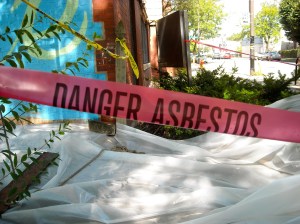
Last week, bright red caution tape surrounded the church building in preparation for the removal of the asbestos transite shingle siding. Work crews suited up in hazmat coveralls and face masks.  Bags and bags of removed shingles awaited removal to a hazardous waste processing facility.  All of a sudden, the building that had been a place of safety and healing was a dangerous and toxic environment!  (For pictures of the project, visit our online photo sharing site: www.flickr.com/kimballavenuechurch.)

Of course, no one knew the dangers of asbestos when the shingles had first been installed back in the 1940s.  Asbestos shingles were “state of the art”, fire retardant and durable.  Unfortunately, asbestos shingles, when broken, release a toxic powder that can cause illness.  As a result, it is extremely expensive to remove and throw away.  Along with the plaster, it is one part of the building that it is impossible to recycle, reuse or renew.

The placement of a “danger” sign outside of the church is ironic.  Jesus, the founder of the Church, was perceived to be dangerous.  Though his ministry was healing and welcome, his message of an alternative Kingdom got him hung on a cross.  The New Testament church in the book of Acts was definitely perceived to be dangerous.  Though they were on a mission of mercy, compassion and “resurrection life”, their message of “Jesus is Lord” was understood as subversive—both to the religious hierarchy and to the empire.  As a result, early church Christians were arrested, jailed, beaten and killed.  The church’s good news of the kingdom was not welcome news to those currently holding power.

The “danger sign” outside the church reminds us that our role in the world is (as Dorothy Day observed) to comfort the afflicted and afflict the comfortable.  The church will be a place of safety for those who have been left outside—the sick, the poor, the imprisoned, the hungry and thirsty.  But the church should always be a sign to those who have grandiose visions of their permanence and power that one day their structures and systems will be torn down to make room for the King of kings.

May the church always be a safe and dangerous place at the same time.

Review of Week 4

Deconstruction moved to the basement of the church, and it is now gutted just like the sanctuary.  The building is just an empty shell with nothing left to identify it as a place where the church met, held services, enjoyed fellowship around the tables, prayed, played games, and shared our spiritual life together.  It reminds me of a barn from my childhood.  There are times when it is hard to watch and there is a sadness that fills my heart.  Yet, the church lives and we continue to meet, hold services, enjoy fellowship around the tables, pray, play games and share our spiritual life together.  It no longer happens at 2324 N. Kimball, but it happens wherever and whenever we gather.  Let the church rise from the ashes!

Review of Week 3

Deconstruction became visible to the community as the work moved from the interior to the exterior of the building.  The vinyl siding on the lower portions of the building and the front entrance canopy were removed.  As it became visible, numerous people stopped by to ask what was happening, giving us the opportunity to talk again about the steam rupture and the way God led us to deconstruction rather than demolition.  Every time I share the story, I hear the same response: “That is so cool.”  And when they hear that men in the neighborhood are being blessed with training in deconstruction, it only adds to their ‘cool’ response.  Our church is pretty cool.

Today, 9/10/11, we moved the stained glass that we are saving from the basement of the church to storage.  The windows are fragile, but thank God none of them broke.  We also took remaining metal items to the scrap yard.  We’re making progress.  Next week, work begins on deconstructing the interior of the basement.   Pictures of the progress so far are posted at www.flickr.com/kimballavenuechurch

Thank You, Alderman Maldonado

Today, the Alderman of the 26th Ward–the Ward where our church is located–visited the work site to take a tour, to meet our trainees and to learn more about deconstruction.  It also gave us the opportunity to express our gratitude to the Alderman for taking the initiative to get a waiver of the required fees from the Building Department.  Thank you, Alderman, for all your support.

Review of Week 2

According to Ken Ortiz of OBI Deconstruction, we are right on schedule.  It’s actually going faster than I anticipated.  As planned, the entire sanctuary has been gutted down to the studs.  It looks and feels like one of the hay barns I used to play in when I was a child.  Workers have started to remove the wood floors.  There is so much wood!

Our trainees have been present every day on time and they are still enthusiastic–quite the accomplishment considering how dirty the work has been.  There is nothing more insidious than plaster dust!  The 95 degree heat only made it worse.  I’m so glad they have a long weekend–no work on Labor Day.

Up next week:  26th Ward alderman, Roberto Maldonado, will visit the project and meet the trainees on Tuesday, September 6, at 2:30 pm.  Watch our flickr.com page for pictures.


Confirmation

Honestly, there have been more than a few moments over the last week when I thought, “Did we make the right decision to deconstruct our building?”  Yeah, it’s ‘green’ and it’s providing training for jobs in deconstruction, but  our church building is going to be gone!

But yesterday, I received a confirmation that God has led us in making the right decision.   God saw something we couldn’t see.  We knew the foundation on the north side of the building was eroding.  We knew there was a hole that had developed where the 1901 building and the 1904 building were joined.  That hole had become the front door for the squirrels who had taken up residence in the attic.  What we couldn’t see until we took out the ceiling and investigated the rafters was that the 1901 building and the 1904 addition are pulling apart!

So, if we had proceeded with repairs to the building, we would have had structural problems later on that would have required thousands of dollars more and–get this!–would have required deconstructing a portion of the ceiling!

We made the right decision.  And God who has led us safe thus far will safely lead us home.  Amen!

Review of Week 1

The first week of deconstruction has concluded and it is amazing what has been accomplished.  Half of the ceiling wood has been removed, the choir loft, baptistry and the platform are gone, a third of the walls no longer have plaster or lath, and the fellowship room is filled with wood of various widths and lengths awaiting transport to the Rebuilding Exchange or storage for future use.

Our deconstruction trainees have filled the dumpster, removed nails from the wood taken from the ceiling and walls, organized the wood by length in preparation for transport and learned how to preserve tongue and groove wood.  The project supervisors have said that we are currently salvaging about 80% of the materials.  As the trainees improve their skills, it will likely go up to 90%

We thank God that everyone has been safe during the work with the exception of a few blisters.  The rain on Tuesday and the heat on Wednesday was a physical challenge, but everyone recovered and is standing on the Word, “I can do all things through Christ who gives me strength.”  Needless to say, all the trainees were happy to see the weekend arrive so their bodies could recuperate.

The work will begin again on Monday, August 29.  The forecast calls for cooler temperatures and dry.  Thank you, Lord.

“Hollowed Ground”

After worship service on August 21, a number of us went into the church building to see what it looked like now that the stained glass windows were removed.  Where there had been a golden glow thanks to the amber and yellow panes, there were gaping holes covered with paneling that had been ripped from the basement walls.  It was difficult–sadder than expected.  The sanctuary seemed empty–dead. It was as if the life was gone.  Someone made the comment, “What was hallowed ground is now hollowed ground.”

However, one window remained–the large window depicting Jesus praying in the garden.  Jesus was praying, “Take this cup from me. Yet not as I will, but as you will.”  Jesus was facing his own “deconstruction”, yet he knew he had to proceed.  He was confident that God had led him to this point, but he struggled with going forward.  That’s how we’re feeling: Knowing this is where God has led us and yet struggling to take the final step.  Standing there in the hollowed place, we felt that Jesus was praying for us.  We are not abandoned.  Jesus came through his “deconstruction” by God’s mighty power.  We will too.