When was the last time you prayed for those in government positions of power? For judges and our courts? As Primary Election Day approaches, pray for those who are leaders and judges. Pray that those who have power will use that power to create policies and administer justice that will lead to peace (shalom) and dignity.
Day 05 Devotional & Discussion- March 10, 2014
Samuel, who has been a judge in Israel for years, appoints his two sons to the position of judge near the end of his life. Yet they turn out to be corrupt. Why do you think Samuel took this step assuming he knew the character of his sons? Where do you see nepotism in our judicial system?
In Illinois, voters choose all judges. At the trial level, there are two types of judges. Subcircuit judges are elected from a defined geographic area and must live in that area. County-wide judges are elected by voters throughout Cook County and may live anywhere in the County. Once elected, both sub-circuit and county-wide judges have the same powers and may be placed in any division of the Circuit Court system. Appellate Court judges are elected in five districts in Illinois. Cook County is one of those districts, and panels of judges on the appellate court hear appeals of civil and criminal cases from all over the County. (If you live in another state, the process may be different.)
Even though judges impact our lives as much as politicians, almost 70% of the voters do not complete the section of the ballot dedicated to election of judges. More than 15% of voters skip it altogether.
Tuesday, March 18, is the Primary Election. There are 60 judge vacancies that must be filled by Cook County voters. Candidates are chosen by the Republican or Democratic parties and often the election is uncontested—for all practical purposes, they are appointed by the party leadership. The Chicago Appleseed Fund for Justice is a non-partisan organization that compiles a list of the candidates and whether they are considered qualified by a number of lawyer groups. See the list at http://www.voteforjudges.org/2014_Alliance_Primary_Ratings.pdf If you are aware of other non-partisan evaluations, please post them.
Devotionals and Discussions
Link to the 2014 Compact Daily Devotional pages to participate in discussions throughout our Fast for Freedom.
Day 04 Devotional & Discussion – March 8, 2014
A woman is caught in the act of adultery. There are witnesses. It’s an open and shut case. And the sentence is clear—death by stoning. But Jesus doesn’t distribute the stones. Instead, he advocates for mercy and second chances.
When have you wanted to pick up stones? How do you react to Jesus’ treatment of the criminal? Do you think Jesus would have reacted differently if the person had been a drug dealer? A burglar? A man? An abusive spouse? How does this passage challenge our system of justice? What do you think would happen if we treated people this way in our courts?
There will be no devotional for Sunday, March 9. Devotionals will resume on Monday, March 10.
Resources to Break the Chains
The Sentencing Project works to eliminate mandatory sentencing. Their web site provides excellent data on how inequitable our judicial and correctional systems have become as well as news related to “enfranchinging” ex-offenders.
The Innocence Project and the Northwestern University Law School’s Center on Wrongful Convictions are two organizations working to exonerate those who are wrongfully convicted. Their web sites include the stories of many men and women who were unjustly condemned and imprisoned. You can also watch stories of wrongful convictions on YouTube
Prison Fellowship International is a global organization advocating for prisoners and their families, the restorative justice model and elimination of the death penalty around the world. To learn more about Restorative Justice link HERE
CLAIM is Chicago Legal Advocacy for Incarcerated Mothers and works to redress the damage caused to children due to having their mother removed from them. They also provide legal educational classes to women who are detained or imprisoned to help them retain their parental rights.
Feel free to post resources you know about as a “comment” below.
2013 Compact
Sharing our food with the hungry. For details link HERE
Day 03 Devotional & Discussion – March 7, 2014
Today’s Scripture is about a cold, calculated murder within the first family. God takes strong action in response to Cain’s murder of his brother, banishing him from the land. However, God does not take his life, but instead places a mark upon him to protect his life.
Would you call God “soft on crime” or a “law and order” God? How does God’s action toward Cain fulfill justice? How do you feel about God’s actions toward Cain first in banishing him and then in protecting him?
Day 02 Devotional & Discussion – March 6, 2014
Genesis 2:16-17, Genesis 3:1-24
The First Infraction…. God established a law–You may not eat from the Tree of the Knowledge of Good and Evil–and laid out the consequences–You will die. Crime and punishment. And you know the rest of the story: Girl listens to serpent. Girl eats fruit. Girl gives fruit to boy. Boy eats fruit. There are consequences. Yet, there is also mercy. God makes garments of skin for the couple to clothe them. Some commentators have suggested that in this act of clothing Adam and Eve, God makes the first animal sacrifice to forgive their transgression, foreshadowing the sacrificial system of the Old Testament and the death of Christ in the new covenant when God will forgive our iniquity and remember their sins no more (Jeremiah 31:34).
We are familiar with crime and punishment in our system of justice. However, we are less familiar with mercy in the midst of the process of punishment. In fact, we have shut the door to mercy through mandatory sentencing, “three strikes” laws, zero-tolerance policies (even for 6 year olds) and sentences that conclude with the phrase “without possibility of parole”.
What do you think about God’s fashion statement? What do you think of a penal system that does not include mercy?
The Church We Were Never Meant To Be – Part 6
Edited text from Pastor’s Message on March 2, 2014
Emphásis on the Wrong Sylláble 1 Corinthians 13:1-13
Accent marks don’t seem like much, but in many languages an accent mark can change the meaning of the word entirely. I am attempting to increase my Spanish language skills through an application called Duolingo. Sometimes, I forget to include an appropriate accent mark when I’m completing a writing assignment and the program will inform me I’ve used the wrong word and deduct points. ‘El’ means ‘the’; ‘Él’ means ‘he’. ‘Si’ means ‘yes’; ‘Sí’ means ‘if’. Or maybe it’s the other way around. I get confused. The point is that an accent mark is all it takes to distort communication. When I put the emphásis on the wrong sylláble, I fail to express myself clearly and I might end up writing something that would be confusing or worse.
The Church at Corinth not only had communication problems (i.e. ‘speaking in tongues’ without interpretation), they were putting the entire congregation at risk by putting excessive emphasis on possessing spiritual gifts. They loved the gifts–especially the most sensational gifts like “tongues”. They held certain gifts and their recipients in high regard while minimizing other gifts and reducing their recipients to second class Christians. They used the gifts to bolster their spiritual status. The most excellent gifts were their highest priority. The results of the wrong empháses were harm to relationships and the mission of the church.
It is in this competitive and destructive context that Paul writes, “I will now show you the most excellent way.” It is not the way of showmanship or boasting or the way of destruction of the body. It is the way that will result in the common good and the edification of the church. It is the way of love. Love must be the priority.
First Corinthians 13 is one of the most well-known passages of Scripture. We usually associate it with wedding ceremonies. In fact, it is so common at marriages that Owen Wilson bet Vince Vaughn in “The Wedding Crashers” that the first reading would be 1 Corinthians 13. It was. Vince Vaughn lost. However, by lifting 1 Corinthians 13 out as if its context within the dysfunctional relationships within the church at Corinth, we miss how important this passage really is. Paul did not write this beautiful ‘love’ chapter to instruct brides and grooms. He wrote it to shift the direction of the church at Corinth away from self-centeredness to “body” awareness and mutual edification.
LOVE IS WHAT IT IS ALL ABOUT. It is not that skills and gifts and abilities aren’t important to the functioning of the church. They are necessary for the accomplishment of the mission. But if gifts are used without consideration for the common good, they are only so much noise and worthless. Gifts and talents and abilities are not given to you for you. They are given to you for the sake of others. Love is always about the other. It is a question of benefit. Who benefits? When the gifts are used in love, everyone benefits. When only the one using the gifts benefits, it is not just unhelpful, it is harmful.
I work with young children every day. Children are not born with an awareness of others. They are completely self-centered and absorbed with their own wants and needs. Part of our job in early childhood education is to help children to “de-center”. In this process, children become aware of other children’s feelings, sharing, helping each other and not hurting each other. It is not a quick and easy process and there are many tantrums and time-outs along the way. Children want their own way; want their needs met first; want everyone else to pay attention to them. They have not grown up. Part of becoming a mature adult is to become unselfish–to live a de-centered life. Such an adult can appreciate and meet the needs of others; can feel empathy in the face of suffering. In 1 Corinthians 13, Paul is implying that the church has been stuck in early childhood. It is time to grow up and become adults. It is time to de-center and make love the highest priority.
In the church, it is love that sets us apart. Jesus told his disciples, “By this, all people will know you are my disciples.” By love. Not by gifts. Not by spectacular healings. Not by speaking unknown languages. Not by supernatural strength. Not by intellect. But by love. The church God wants us to become, emphasizes the common good, shifting the emphasis from self-interest to the interests of all. The church built on the foundation of love will seek the welfare of the weakest among them knowing that the health of the weakest will ensure the health of all. The early church understood this and acted from the beginning to take care of each other’s needs–providing assistance to the poor, eating together, practicing Jubilee. They acted like a community that sought the common good–not individual glory.
How different from our culture that emphasis self-actualization, personal fulfillment, individual goals, and selfish pursuits, climbing the ladder of success. Unfortunately, what we experience daily and what is idealized in our culture tends to walk through the church doors. The result is a church that acts out of similar priorities with a veneer of spirituality. Such a church quickly degrades into the church at Corinth.
But there is a more excellent way. There is Jesus’ way of love. The results will be a church where everyone is valued, everyone is accepted, everyone is edified and where everyone uses their talents, abilities and spiritual gifts to accomplish the mission to be the hands and feet of Jesus in the world. And such a church will live out God’s alternative vision for the world–a world where the emphásis is put on the right sylláble–the sylláble of LOVE.
The Church We Were Never Meant To Be–Part 5
 Edited Text of Pastor Ray’s message on February 23, 2014
“Body Dysfunctions” 1 Corinthians 12:1-31
I grew up in a church where every Sunday was pretty much the same. We sang old hymns. We read the Bible. We stood during the (long) congregational prayer. We sat still and listened to sermons (though I frequently wrote notes to my friends on my bulletin). And after a closing blessing, we solemnly filed out of the sanctuary. We all knew what to expect. But then I went to college and I was introduced to a very different church experience. There was freedom and excitement and enthusiasm. People lifted their hands, the music was joyful and sometimes there was even dancing in the aisles. Sometimes people were healed. Often, people would speak in tongues that no one seemed to understand–except occasionally when someone would interpret. And there was no bulletin! Each week, there was a sense of anticipation and wonder. One never knew exactly what would happen next. The experience was liberating for me and I wanted to experience more.
It was during this time that I was told about the “baptism of the Spirit”. All the joy and exuberance was because people had been filled with the Spirit. I wanted it. So some friends of mine gathered around me, laid hands on me and prayed that I, too, would receive the baptism of the Spirit. We waited. We continued to pray that God’s spirit would fall. We waited some more. We were waiting for me to receive the evidence that our prayers were answered. I was supposed to speak in tongues. I didn’t. I wanted to. I was told that I needed “just let it happen.” Honestly, I tried. I followed all their instructions. I babbled to “prime the pump.” Nothing happened. I needed to persevere. I persevered. Still nothing happened.
Since I didn’t receive the gift of tongues, and God says, “ask and you shall receive,” obviously something had to be wrong with me. Maybe, I didn’t have enough faith. Maybe I was blocking the movement of the Spirit as a result of some sin. I confessed every sin I could think of. I read the Bible cover to cover so I would better know God’s will. I learned all I could about the gifts of the Spirit. I prayed–hard. I still didn’t speak in tongues. Though no one said it, I felt like a second-class Christian. There were other gifts of the Spirit, but speaking in tongues was THE evidence I expected. It was the evidence that everyone else around me expected. It was the one gift above all others that mattered; that made my infilling of the Spirit valid.
Now that I have matured in my walk in the Spirit, I realize how dysfunctional my college experience had been. Because there was so much focus on what I had not received, no one could appreciate what I had received–gifts that ultimately propelled me into pastoral ministry and prepared me to help others on their spiritual journey. The problem was not that people were speaking in tongues–a legitimate expression of the Spirit’s presence in person’s life, but that speaking in tongues was held up as the only legitimate expression of the Spirit’s presence and as the pinnacle of personal spirituality. Along the way I discovered that God had much more to say about spiritual fruit as evidence of the Sprit’s presence. An over-emphasis on spiritual gifts–especially elevating one gift above all others–was evidence, not of spiritual maturity but of spiritual dysfunction.
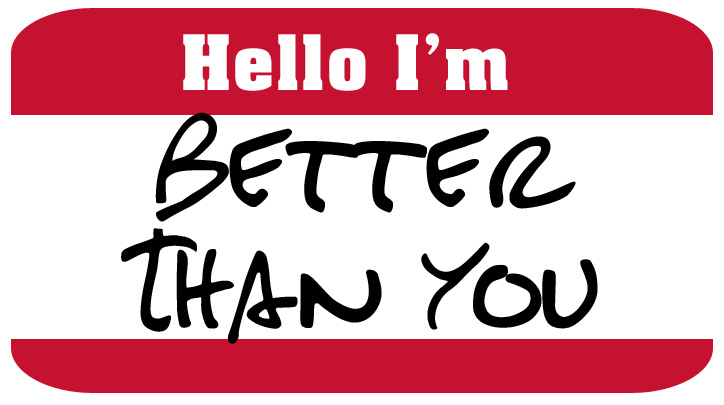
The church at Corinth exemplified this very dysfunction. They too were exalting one gift over all others and were minimizing the other manifestations of the Spirit. And they were minimizing those members of the church that did not show evidence of greatest spiritual gift–the gift of speaking in tongues—especially “angelic tongues”. Those who spoke in tongues were more spiritual than those who did not. Those who did not speak in tongues were inconsequential and unnecessary. Possession of THE gift led to spiritual pride and social arrogance. They might as have well worn “I’m better than you” buttons.
Such dysfunction ultimately destroys the church and prevents it from fulfilling its God-given mission. Paul writes to clarify in no uncertain terms that there are MANY spiritual gifts from God and ALL gifts are necessary to the healthy function of the church. AND the Spirit distributes the gifts not on the basis of some maturity hierarchy, but as the Spirit wills. Not every member will be a prophet. Not every member will speak in tongues. (Why hadn’t my college friends read that to me?) Not every member will have the ability to heal. Therefore, we need each other and the full range of spiritual gifts.
There is unity within the body of Christ, for we are all baptized by the Spirit into one body, but that does not require uniformity. In fact, it requires many parts. To illustrate his point, Paul used the analogy of the human body–a single body made up of many parts–some visible, some protected inside the body, some covered out of modesty, some seemingly inconsequential. However, ALL parts are indeed needed. To exalt one gift or one calling or one perspective over all others will only result in spiritual disability. To denigrate certain parts just because they are not visible or because they are small; to say to any part, “I don’t need you,” is the height of arrogance.
Their hierarchical understanding about spiritual gifts had also led them to a hierarchical attitude toward those who possessed the lesser gifts. The church had once again divided itself into a group of “haves” (they have the gift) and the “have-nots” (they have not the gift). This was beyond social class structure–another issue in the church. Now the church was creating a spiritual class structure! And the “haves” had little concern about the well-being of the “have-nots”.
The purpose of spiritual gifts–all the gifts–is for the upbuilding of the entire church. It is for the common good. Mutual edification can only occur in an atmosphere of humility and love (the more excellent way of 1 Corinthians 13). For the common good to flourish, we must treat each other as though they are God’s gift to us.
The church that God means for us to be is a church that values diversity of gifts and diversity of people demonstrated through respect, mutual care and equality. Unfortunately, many churches, while giving lip service to diversity, have actually pursued segregation. One of the foundational principles of the Church Growth Movement is that churches can only grow in homogeneous groupings of people. In a book entitled, Our Kind of People, C. Peter Wager wrote, “men like to become Christians without crossing racial, linguistic or class barriers”. Therefore, segregated churches based on socio-economics, education, race, language, generation and even spiritual gifts have been (and continue to be) planted throughout America. Rather than the church embracing diversity and the gifts of different cultures, experiences and perspectives, the church has chosen instead to organize itself on the principle of “separate but equal” (which is never truly equal) and on the de facto statement, “I don’t need you.” This structure has resulted in mega-churches and mega-church wannabes that have little power to challenge the status quo. And because the body of Christ is not engaging the gifts of all the members, the result is a church that has actually lost its voice. We can hardly speak about systemic injustice when our own systems mirror the injustice.
The church needs a reformation which affirms the need for all gifts, experiences and perspectives. The church needs to make new choices about welcome and inclusion. The church needs a structure that allows for those of “lesser gifts” to do their part with great respect and honor. While diversity of people and gifts within a denomination or a local church is challenging, it is what God desires. Isn’t that why God gave us the Spirit in the first place–to empower us to do God’s will in the world and to be God’s witnesses across all lines of division?
 Tongue on Fire