A Disturbing Message (follow-up)

There has been an unexpected twist in the burning cross incident that occurred 10 days ago in Chicago’s Grant Park. After surveillance photos of “a person of interest” were distributed, Merlin Lu — a 21-year-old college student from Naperville, IL — contacted NBC5 reporter Chuck Goudie and confessed. Lu admitting setting the cross on fire, but said that he had no idea of the history of cross-burning or the connection to racial intimidation. He claimed that he set the cross on fire to protest the Trump administration. As evidence, he pointed out that he had placed a MAGA hat at the top of the cross before setting it ablaze. Lu has since turned himself into the Chicago police. Lu has been charged with a felony hate crime.

If Lu is telling the truth that he didn’t have a clue, I’m still disturbed that he was so ignorant. He graduated in 2022 from Neuqua Valley High School in Naperville–a public high school that has been recognized for its academic excellence and is listed among the top 400 high schools in the nation with a graduation rate of 96%! In 2017, the school received the National Blue Ribbon Award from the US Department of Education in recognition of student achievement. So, I checked out the Social Studies curriculum at Neuqua Valley to get a sense of what Lu probably had been exposed to. According to the current course of study, he would have been required to take a course on US history in his Sophomore year. The curriculum lists Civil Rights as a focus in the second semester. Of course, that does not mean that the history of cross-burning by the Ku Klux Klan (KKK) is included in the instruction. But even if it was, Lu may not have been in class the day it was taught.

However, there was something else I learned while going down the rabbit hole. On the first day of the 2015-2016 academic year, a student came to Neuqua Valley High School wearing a Confederate Flag T-shirt, igniting a firestorm on social media and setting off a debate about freedom of speech.. While this occurred two years before Mr. Lu entered high school, controversies like the display of a Confederate Flag usually don’t die down quickly or without ramifications. One would think (or at least hope) that the Social Studies department would have been instructed to address Civil Rights more thoroughly so that students would understand the triggering nature and power of symbols.

Maybe the department did address hate symbols and racism. Maybe it didn’t. Either way, let’s be honest: we’ve never done a very good job teaching students US History generally or Civil Rights history specifically. And we are losing ground as we prepare to celebrate the 250th Anniversary of the founding of the United States. Museums have been told to “adjust” their displays to reflect only the greatness of American history. The National Park Service has been ordered to remove plaques that portray the founders in a negative light (most of them were enslavers). Web sites have been scrubbed. DEI initiatives have been rolled back. Critical Race Theory has been vilified. New history curriculum has espoused new interpretations of the past–like slavery was beneficial for African-Americans. (That gem comes out of PraegerU, a curriculum that is being used in a growing number of schools across the nation–including elementary schools.)

Was Mr. Lu ignorant of the symbolism of a burning cross? If he was ignorant, there are probably thousands of 21-year-olds (or older) that are equally uninformed. But, in my opinion, even if he was ignorant of the symbolism, charging him with a felony hate crime does not teach him much. He has admitted his offense and recognized its impact.. It would be so much better to sentence him to community service hours with an organization like NAACP (or a similar group) that would help him to understand our national racist past and give him the opportunity to connect to those he triggered when he lit the match.

And let’s be honest: it’s not likely that you will see (or light) a burning cross , but there is plenty of racism all around us (and in too many of us). I find it very disturbing that many of the same people who condemned a burning cross have been silent after Josh Hoykit (age 28), praised Jesus in one breath and in the next declared, “Michelle Obama is a man,” following his victory at #47’s birthday UFC cage fight. He needs community service hours and a re-education too.

Come to think of it, maybe we all need to be re-educated–especially on this Juneteenth holiday. Community service would benefit us all too.

Should Schools Post the Ten Commandments?

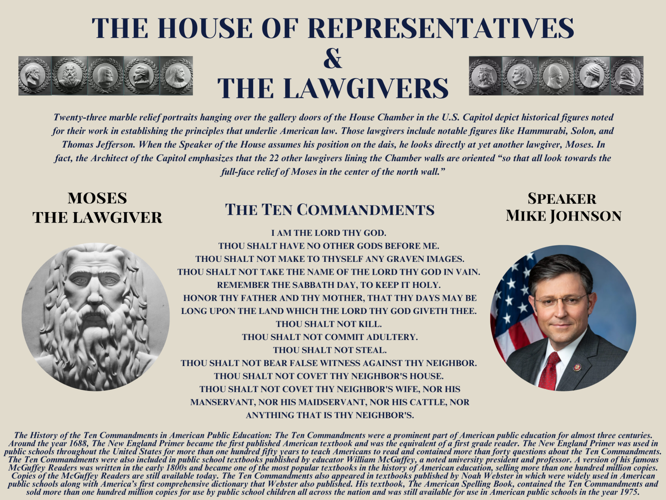
On January 1, 2025, a new Louisiana law went into effect that requires all public schools to display a poster of the Ten Commandments in every classroom. Five school districts challenged the new law in U.S. District Court last Fall after Governor Jeff Landry signed the bill. The judge ruled that the law was unconstitutional, but the State of Louisiana has appealed the decision to a higher court. In the meantime, the State has said that the lower court’s ruling only applies to the 5 districts that brought the suit and that the other 67 districts in the State must comply with the law. According to the Associated Press, there is no evidence that any public school has put up the posters to date due to all the confusion.

Back in 1980, the Supreme Court heard the case of “Stone vs. Graham.” The State of Kentucky had passed a law similar to the new Louisiana law that required every school post the Ten Commandments. The justices ruled that the Kentucky law violated the “establishment clause” of the U.S. Constitution, which says Congress can “make no law respecting an establishment of religion.” The justices did not see any reason for posting the Ten Commandments other than for religious purposes. We’ll have to wait and see if Louisiana’s version will end up in the Supreme Court and how this Court will rule.

Posting the Ten Commandments in schools seems to have become the new front in the culture wars. According to the conservative Christianity Report newsletter, Republican lawmakers in at least 14 other states have introduced legislation to require the display of the Ten Commandments in public school classrooms.

So is posting the Ten Commandments in schools a good idea? Will hanging a poster result in students with better reading scores and math skills? Ok, that’s a little facetious. But seriously, what IS the goal–besides putting a reference to God on the wall? Do we think the poster will turn students into law-abiding citizens? Do we think the poster will create a better learning environment. Honestly, a poster isn’t the answer.

My wife is a public school teacher and administrator. She has dealt with students from a variety of religious backgrounds and no religious background. She never hung a poster of the Ten Commandments in her classroom, yet every student knew that they were expected to behave in a manner that preserved the dignity of their classmates and created a healthy classroom community. She didn’t need a poster to remind her students not to take things that didn’t belong to them, or to not to make false accusations or slander their classmates, or not to intentionally harm one another physically or emotionally. And she didn’t need to post a Bible verse to encourage her students to treat one another the way they would want to be treated. Thankfully, the 10 commandments weren’t posted in her classroom. What teacher would want to answer when an inquisitive 2nd grader innocently asks, “Mrs. Ray, what does it mean to ‘commit adultery?'”

There are other reasons why posting the Ten Commandments in schools is a bad idea.

First, every sample poster developed for Louisiana classrooms (including the one with a photo of House Speaker Mike Johnson) uses the King James translation of the Bible. English language learners (including children born in the US to English-speaking parents) have enough trouble with the crazy rules of the language (like the silent ‘B’ in the words ‘comb’ and ‘tomb’–which don’t rhyme though they look like they should). All the Old English ‘Thee’s’ and ‘Thou’s’ and ‘Thy’s’ and ‘Shalt’s’ in the text will only make a difficult language even harder to learn.

Second, posting the Ten Commandments will not serve the political agenda of those who passed the law. Do we really want students to learn the Ten Commandments and then use those standards to evaluate the behavior of their representatives, senators and president? No other Gods? No adultery? No graven images? No false testimony or rumor-mongering? What students will REALLY learn is the meaning of the word ‘hypocrite.’ Rather than creating better-behaved, more moral citizens, the poster will create a generation of cynics who watch adults in power break the very rules posted on the wall for their own agendas.

Come to think of it, maybe posting the Ten Commandments in every Louisiana classroom IS a good idea. Every student could memorize them, then attend a Town Hall meeting with their Louisiana Representatives. There, they could recite all ten, then ask their Representative the question: “Do you think that someone who has broken one or more of these commands should be elected to public office?”

I would love to hear the answer from one particular Representative from Louisiana’s 4th District.

Living Woke – Week 3

Psalm 78 is a Jewish History curriculum for grades K-12. It is written by Asaph to parents who are reminded of God’s mandate that they tell the stories of the past to their children so that the next generation will learn and subsequently pass along the stories to their children.

The goal of the history lesson is two-fold: first, to ensure that each generation will understand God’s role in their history and put their hope in God (vs.6-7) and second, to avoid repeating the mistakes of the past. (vs. 8). The rest of the Psalm is account after account of ancestral sin and rebellion against God. The ancestors are not models of virtue, faith or courage. They are presented as ungrateful whiners and faithless idolaters. Despite God’s grace, forbearance and provision, the people keep turning away from God to lawlessness..

THAT is the honest truth. Instead of offering a litany of heroic battles and iconic personalities, Asaph reminds his parent/teachers that those who fail to known the past and learn from it are bound to repeat it. This is hard history for a better future.

Right now, there is a battle over the stories we tell our children. Some are demanding that we tell the truth, the whole truth and nothing but the truth. And the truth is hard–the American apartheid, the forced removal of indigenous peoples from their lands and the slaughter of those who resisted, the generational enslavement of Africans, the lynching trees and the systemic discrimination and disenfranchisement of minorities. Christian author, Jim Wallis, has identified racism and white supremacy supported through Christian Scriptures and manifest destiny as “America’s Original Sin.”

But there has been backlash to all the truth-telling. Many others want to silence the hard history and erase the memory of those who challenged the status quo. They prefer the patriotic stories of the past–the stories of American exceptionalism and American superiority and American glory. Thanks to an Executive Order signed on January 29, 2025, entitled, “Ending Radical Indoctrination in K-12 Schooling,” the hard truths of American history are being whitewashed. The president calls the efforts to include the darker parts of our history “anti-American, subversive, harmful and false,” and demands instead that schools devote themselves to “patriotic education” that will “instill a patriotic admiration for our incredible Nation.” A “Patriotic education” is defined in the following way:
(i) an accurate, honest, unifying, inspiring, and ennobling characterization of America’s founding and foundational principles;
(ii) a clear examination of how the United States has admirably grown closer to its noble principles throughout its history;
(iii) the concept that commitment to America’s aspirations is beneficial and justified; and
(iv) the concept that celebration of America’s greatness and history is proper.

While all that has a ring of noble intent, the ultimate goal is to stifle critical analysis and silence honest assessment of our past.. Embedded in the Executive Order is the elimination of ‘‘Discriminatory equity ideology’” (code for Diversity, Equity and Inclusion and Critical Race Theory.) As a result, we are literally watching history disappear.

Last fall, my wife and I followed a portion of the Civil Rights trail, starting in Atlanta, Georgia, traveling to Montgomery, Alabama, with a day trip to Selma. The trip was filled with hard history. On the return trip to Atlanta, we spent several hours at the Tuskegee Airmen National Historic Site. It was a sacred place of endurance and resilience, of struggle and strength. Legalized segregation was used to keep them in the shadows, but it could not keep them from shining. The Tuskegee Airfield is now a National Park Service museum campus that tells their stories.

But despite their accomplishments and the honor that has been given to these persevering pilots and mechanics, the Department of Defense began removing all references to the Tuskegee Airmen from its web site on March 7. Also removed were pages dedicated to Jackie Robinson and the Navajo Code Talkers. It was all a part of complying with the Executive Order that required the removal of anything that seemed to promote Diversity, Equity and Inclusion (DEI). Thankfully, due to the outcry of thousands of veterans, the Pentagon has returned some–but not all–of the pages and images.

Our nation has a long history of progress toward the ideal of “justice for all” followed by periods of backlash and regression. We are in a time of regression. But those whose eyes are opened must not give up or give in. We must keep telling the truth about our past and tell the stories of those who overcame adversity so that our children and their children will learn of God’s ways and renounce the sins of their ancestors. The future depends on it.