The Crucifixion and Burial of Kilmar Abrego Garcia

Every Good Friday, whether you are Roman Catholic, Episcopal, Lutheran, United Methodist, or UCC, Isaiah 53 will be included in the readings for the day’s worship service. The passage describes the suffering of God’s innocent servant. And though it was written long before Jesus walked the earth, it uncannily mirrors the events of Jesus’s arrest, sham trial, execution and burial. But as I was reading the Isaiah 53 today–especially verse 8–another innocent man came to my mind.

Isaiah 53:8 – ‘The Voice’ translation

Oppressed and condemned, he was taken away.
    From this generation, who was there to complain?
Who was there to cry “Foul”?
    He was, after all, cut off from the land of the living,
Smacked and struck, not on his account,
    because of how my people (my people!)
Disregarded the lines between right and wrong.

The innocent man’s name is Kilmar Abrego Garcia.

Garcia, a legally protected immigrant, was detained by ICE without cause, condemned without due process, cut off from his family and from legal protection, and buried in a notorious prison (known as CECOT) in El Salvador by the US government that first admitted his deportation was an “administrative error”, then claimed it had no power to find him or extract him, and now claims to have found “proof” of his gang affiliation, justifying his deportation to CECOT. The President of El Salvador has also refused to release him, claiming he is a terrorist.

Despite advocates who have cried, “FOUL!” and despite judges (including the Supreme Court) who have ruled in his favor, he remains–and likely will remain–buried because of the blatant disregard for the law and the lines between right and wrong.

Kilmar Abrego Garcia has been crushed before our eyes. He is not the only one.

Mahmoud Khalil was accused of terrorism for exercising his right to freedom of speech. His crime was speaking against the genocide in Gaza at Columbia University in New York; He was detained by ICE without being charged of a crime and sent to a Louisiana detention center over a 1000 miles from his legal representative and his pregnant wife–a US citizen. This week, a Louisiana judge ruled that Department of Homeland Security can proceed with his deportation. DHS has claimed that he is a threat to national security.

Jose Barco, a US veteran, served two tours in Iraq and was awarded a Purple Heart for his heroic actions to save his fellow-servicemen when a bomb exploded. Barco suffered PTSD and a traumatic brain injury from the explosion which was never adequately treated. Following his service, he applied for naturalization–a process that was never completed. DHS tried to deport him to Venezuela, but the country denied him entry. He now sits in an ICE detention center in Colorado while the US government decides what to do next.

Jerce Reyes Barrios, a Venezuelan who followed all the rules to seek asylum, was detained and sent to CECOT without due process, accused of being a gang member solely on the basis of a tattoo and a hand gesture.

Mario René López, a US citizen, has been sitting in a Virginia ICE detention center for 2 years due to legal questions regarding the validity of his citizenship claim.

Every day, innocent people are being harassed and taken away–leaving children without mothers and fathers. Some are disappeared, buried in detention centers and foreign prisons. And few of God’s people are objecting or crying “Foul!” Some even support the lawlessness and the cruelty of these unjust detainments and deportations.

I’ve often thought of the crowd crying out for Jesus’s crucifixion and asked myself, “How could they condemn an innocent man?” I’ve also wondered, “What would I have done if I had been there?” Jesus is being crucified again and again, and we are there.

We need to ask ourselves, “What are we going to do?” Will we disregard the line between right and wrong? Will we be silent? Will we turn away and be complicit through our denial? Will we, like those in Isaiah 53:4, “consider him punished by God,  stricken by [God], and afflicted,” not realizing that it is we that have gone astray and that Jesus’s suffering is because of our sin? Or will we cry “Foul!”? God, help us.

Losing Our Souls

“What do you benefit if you gain the whole world but lose your own soul?” (Mark 8:36 – New Living Translation)

I grew up in the Evangelical World of Billy Graham crusades, Biblical inerrancy and Bill Bright’s “Four Spiritual Laws.” There was a strong emphasis on rejecting the morals and values of “the world” and adherence to the morals and behaviors of holiness. Frequently, that was defined for us as not smoking, not drinking, not using foul language and not having premarital sex. We were reminded of the warning in James 4:4 that “friendship with the world means enmity against God? Therefore, anyone who chooses to be a friend of the world becomes an enemy of God.” and the command of 1 John 2:15, “Do not love the world or anything in the world. If anyone loves the world, love for the Father is not in them.

Theologically, I’ve shifted to a broader understanding of “the world” and “holiness” that focuses less on individual behavior choices and more on the ethics of love, service, mercy, justice, shalom–ethics of the kingdom of heaven that are not frequently found in the “world” that values wealth accumulation, ambition, retribution, and domination..

Sadly, I’ve watched the American church (of many stripes) shift as well. Oh, it still wants us to maintain the individual behaviors of holiness, but it has redefined “the world” to accept (and even advocate for) values and morals that are antithetical to the way of Christ–values like political power, coercion, retribution, cruelty, abuse, and even lawlessness. Kingdom of heaven values like compassion, empathy, peace-making, humility and welcome are seen as weak, ineffectual, and “woke.”

There are people within the American Church that believe that the United States should not be a democracy, but a theocracy. And they have advocated for the playbook of domination and autocracy to ensure that the US becomes and remains a “Christian Nation.” Yet, the very pursuit of “gaining the whole world” has come at a great cost. In my opinion, the Church has lost its soul–its connection to life in Christ and the mission of Christ, exemplified in his act of servanthood and articulated in his commandment to “love one another as I have loved you.” (John 13:33-34)

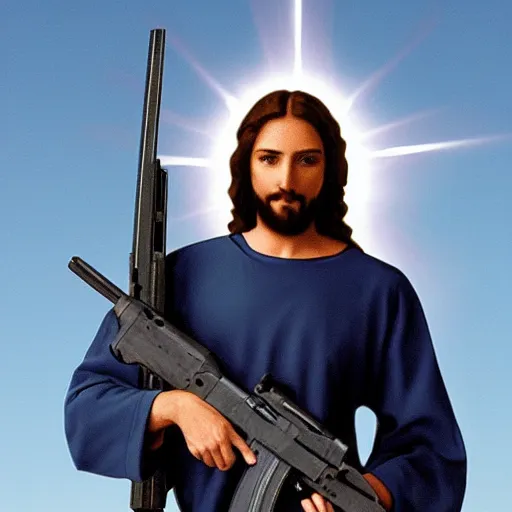
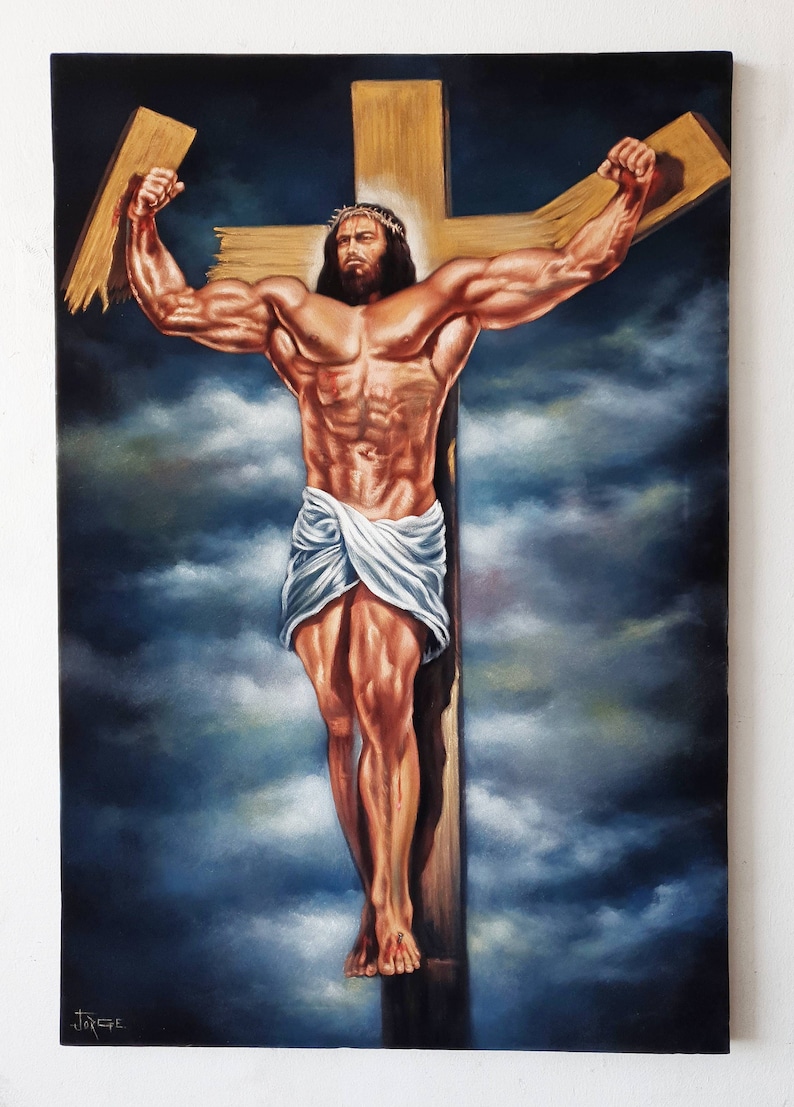
No longer do we lift up the Jesus who took the role of a servant and washed the feet of his disciples; no longer do we admire the Jesus came to seek and save the lost; no longer do we want a Savior who “gives up” ambition to lift up the humble. Now, we see depictions of “Warrior Jesus” and “Body-builder Jesus” and even “Patriot Jesus.” Jesus warned that “those who want to save their life will lose it.” Jesus also promised that “those who lose their life for my sake will save it.” See Luke 9:24.

So, on this Maundy Thursday, let’s reclaim our souls and reject the ways of the world in favor of the Way of Christ. Pick up a towel and serve, feed the hungry, comfort the afflicted, visit the lonely, defend the weak, welcome the outcast, love one another.

Which King?

Pilate asked them, “Shall I crucify your King?” The chief priests answered, “We have no king but Caesar.” (John 19:15)

Throughout this season of Lent, I have found myself asking the question, “What does it mean to follow Jesus in this moment in history when a President of the US has orchestrated the end of democracy as we have known it and replaced the three equal branches of government with a single authority–in practice, making himself King? Navigating this new reality has included fear, anxiety, fear, concern, and.more fear. But it also has led me to ask another question: To which king will I pledge loyalty in the end?

At Jesus’s trial, Pilate presented a choice to those calling for Jesus’s crucifixion. Where was their allegiance? King Jesus or King Caesar? The Chief Priests (who were appointed by Rome) made their choice clear: “We have no king but Caesar!” Their allegiance was ultimately to Rome and the policies of the Empire. To choose Jesus as their King would have put their positions at risk. For them, affirming their loyalty to Rome was a no-brainer.

Shadrach, Meshach, and Abednego were faced with a choice when King Nebuchadnezzar set up the golden statue and demanded that everyone bow down and worship it. (See Daniel 3) This was a classic loyalty test. Shadrach, Meshach and Abednego refused to bow down, and they faced the consequences with great courage. And there are always consequences. For them, rejecting loyalty to Nebuchadnezzar was a no-brainer. Their loyalty was to God and God alone.

In these times, we are faced with a choice. Loyalty to the governing ruler (the ‘Caesar’) promises job security, funding, protection and perks. Show any disloyalty, speak against the ruler, or protest unjust policies and you may end up in a foreign prison. More loyalty tests are sure to come, and NOW it is time to stretch and strengthen our resistance muscles.

On Holy Saturday, I plan to attend a protest rally downtown. The most recent threats to migrants (ie deportations without due process and the required Migrant Registry that will result in deportations without due process) and ongoing threats to Medicaid demand a response. I’m going to take a sign with me. It will read, “I have no king but Jesus.”

You’re welcome to stand with me.

Palm Sunday Is a Protest

Yesterday, like many Christians around the world, I waved my palm branches as I processed around the church sanctuary and shouted, “Hosanna!” in honor of Jesus’s “Triumphal Entry” into Jerusalem. The gathered congregation welcomed Jesus, the King of Kings, into the safety of our sacred space. We sang praise songs, we prayed prayers of thanksgiving, we read the Scriptures and listened to Rev. Lindsey Long’s sermon.

The sermon started with a provocative assessment: “Palm Sunday was a well-organized protest march.” Think about it: the “King” riding on a donkey (subverting a Roman military parade); the Palms (a proud symbol of marginalized identity waved in defiance); the chants (“Blessed is the One who comes in the Name of the Lord!”–a direct challenge to the “ones” who come in the name of Empire.) No wonder the authorities tried to stop the event. We know that even peaceful protests can be met with violent resistance. Palm Sunday could have easily turned into “Bloody Sunday.”

Most Palm Sunday worship services end with a Benediction and congregants filing out of the church with their palms in tow to return to the comfort and safety of their homes. Not this one. We took our palms and followed Jesus and the donkey (OK, they were people in costumes) through the streets to protest the policies and executive orders that are dismantling the programs and protections of those who are most vulnerable in our community: Families who depend on SNAP benefits, children who rely on MedicAID, migrants who are being illegally deported without due process, people of color, people with disabilities, and LGBTQIA+ folk who are villainized and devalued. But we also announced the coming of the ONE who is the Way, the Truth and the Life and the Good News of the arrival kingdom of heaven where ALL God’s creatures thrive through the reign of God.

Pastor Lindsey reminded us that protest is a holy act. It is using our feet and our voices to denounce the workings of the principalities and powers and to announce the Good News of shalom and salvation to all of creation. So, keep your palms, put on your walking shoes and practice your chants.

“How beautiful on the mountains are the feet of the messenger who brings good news, the good news of peace and salvation, the news that the God of Israel reigns!” (Isaiah 52:7 – NLT)

It’s time for some Holy Protest.

On Saturday, April 19, in cities and towns across the nation, people will be taking to the streets in an act of resistance to the cruel and destructive acts of this administration. Locate a rally close to you HERE. Search for your city or zip code.

Burying Dissent; Sprouting Hope

“They tried to bury us, they didn’t know we were seeds.” *

We really wanted to be back in Chicago on Saturday, April 5, to participate in the “Hands Off!” rally at the Daley Center. Instead, we were on a flight back to the US–a flight that finally landed in Boston just shy of Sunday, April 6. When we arrived at our hotel, we were exhausted (travel depletes me), but we were so curious about the rallies that had been held across the country that we turned on the television hoping to find some news. To our disappointment, we saw and heard nothing.

On Sunday, April 6, we got our digital copy of the Chicago Sun-Times, expecting to see coverage of the rally on the front page. Nothing. We scrolled through the pages and finally found a photo and brief story on page 22. Page 22!! We later learned that an estimated 5 million people across the country took to the streets in over 1400 “Hands Off!” rallies across the nation to oppose the Trump/Musk dismantling of the government. Despite the numbers, the media across the country minimized the dissent. The New York Times placed the story on page 18! CNN’s story began with the sentence: “Scores of people took part in protests…” Fox News reported that “Thousands of people gathered across the US.”

Scores? A score is 20 people! Thousands? That was just in Traverse City, Michigan, where 4,000 attended. Why was the media burying the story and minimizing the numbers? Maybe the answer is that peaceful protest doesn’t sell papers or attract viewers. Maybe the answer is that corporate media has been sued by the administration for defamation and threatened with loss of broadcasting licenses and they are running scared. But most likely, the answer is that the owners of the media are part of the oligarchy (such as Jeff Bezos of the Washington Post) who don’t want to fan the flames of discontent. Minimize the dissent, don’t draw attention to the protests, and maybe–hopefully–it will die out.

But the dissent isn’t dying. The resistance is rising and hope for a different future is growing.

On Monday, April 7, Anthony Joel Quezada was sworn in as the newly appointed Alderperson of the 35th Ward in Chicago. That evening, he held a “People’s Inauguration” to celebrate with his supporters. We were privileged to join hundreds (not scores) of our neighbors to congratulate Anthony on his new position.

Anthony Quezada is 29 years old. He is a child of immigrant parents. He has been involved in community organizing and political action since he graduated from Lane Tech High School. He is a bright, articulate, passionate man who is committed to a new kind of governance–a politic rooted in community empowerment and collaborative decision-making. When Anthony took the microphone on Monday night, he didn’t speak about what he was going to accomplish or his legislative agenda. He spoke about what we could–and would–do together to ensure that all voices were heard, all people were treated with dignity, all residents were protected, and all those so frequently excluded were included.

We walked away from the evening full–full of hope as we watched a new generation of visionary leaders take their place. And I heard Mary’s Song welling up in my heart anew: “The Mighty One has brought down rulers from their thrones but has lifted up the humble. [The Mighty One] has filled the hungry with good things but has sent the rich away empty.” (Luke 1:52-53)

Amen! Amen! Amen!

The quote at the beginning of this post is often referred to as a Mexican Proverb. However, the origin of the phrase is from Nicaraguan poet, Catholic priest and theologian, Ernesto Cardenal.

Finding Peace in Anxious Times

I haven’t posted for over a week due to being out of the country. While I was away, I had enough access to the news from the US (tariffs, deportations, market collapse, etc), that I actually had “anxiety dreams”–something I had not experienced in years. I dreamt that I had been arrested for my blog posts. I dreamt that I wasn’t able to get back into the United States. I dreamt that the dollar was worthless.

It happened several nights in a row. And each morning I would awake, wondering if I would return to the same United States that I had left just a week before. The news cycle indicated that it was indeed different–and not in a good way.

I shared my dreams with my wife, who wisely reminded me that I needed to stay focused on God’s word and not on the circumstances that were out of my control. She has been using Psalm 90:1-2 as her daily focus and suggested that I pray that God would give me a verse as well. I did; and God did.

The next morning, I was awakened not with an anxiety dream, but with the voice of Jesus, repeating a phrase over and over. It was his last words to his disciples before leaving: “I am with you always, even to the end of the age.” (Matthew 28:20b) I’ve been repeating it daily ever since.

I was able to get back into the country. I haven’t been arrested (at least not yet). The shit show is still shitty as ever. (It’s the only word I have to describe it.) I have no illusions about the state of our democracy and the struggle we may face. But I think about those early church disciples and their “Roman Reality.” They faced opposition, and they experienced rejection. They were falsely accused; they were jailed; they were beaten; some even died. But they still spoke the truth and stood firm, and they even found joy together in the middle of their struggle, singing hymns in chains. I can imagine that they repeated Jesus’s final words as their morning mantra. And then they got out of bed and walked by faith.

Yes, Christ is with us. Always. Even to the end of the age. Yes. This age will end, and Christ will still be with us. Always. No matter what. Always.

(S)heroes of the Faith

If you’ve never heard of Rev. Pauli Murray and their story of faith-rooted activism, you’re not alone.

However, their story is in danger of being completely erased by the National Park Service in compliance with this administration’s order to end all references to DEI.

Learn about Rev Murray in this article published by Sojourners. https://sojo.net/articles/news/trump-administration-erases-page-honoring-trailblazing-priest-lawyer-and-activist

Should Schools Post the Ten Commandments?

On January 1, 2025, a new Louisiana law went into effect that requires all public schools to display a poster of the Ten Commandments in every classroom. Five school districts challenged the new law in U.S. District Court last Fall after Governor Jeff Landry signed the bill. The judge ruled that the law was unconstitutional, but the State of Louisiana has appealed the decision to a higher court. In the meantime, the State has said that the lower court’s ruling only applies to the 5 districts that brought the suit and that the other 67 districts in the State must comply with the law. According to the Associated Press, there is no evidence that any public school has put up the posters to date due to all the confusion.

Back in 1980, the Supreme Court heard the case of “Stone vs. Graham.” The State of Kentucky had passed a law similar to the new Louisiana law that required every school post the Ten Commandments. The justices ruled that the Kentucky law violated the “establishment clause” of the U.S. Constitution, which says Congress can “make no law respecting an establishment of religion.” The justices did not see any reason for posting the Ten Commandments other than for religious purposes. We’ll have to wait and see if Louisiana’s version will end up in the Supreme Court and how this Court will rule.

Posting the Ten Commandments in schools seems to have become the new front in the culture wars. According to the conservative Christianity Report newsletter, Republican lawmakers in at least 14 other states have introduced legislation to require the display of the Ten Commandments in public school classrooms.

So is posting the Ten Commandments in schools a good idea? Will hanging a poster result in students with better reading scores and math skills? Ok, that’s a little facetious. But seriously, what IS the goal–besides putting a reference to God on the wall? Do we think the poster will turn students into law-abiding citizens? Do we think the poster will create a better learning environment. Honestly, a poster isn’t the answer.

My wife is a public school teacher and administrator. She has dealt with students from a variety of religious backgrounds and no religious background. She never hung a poster of the Ten Commandments in her classroom, yet every student knew that they were expected to behave in a manner that preserved the dignity of their classmates and created a healthy classroom community. She didn’t need a poster to remind her students not to take things that didn’t belong to them, or to not to make false accusations or slander their classmates, or not to intentionally harm one another physically or emotionally. And she didn’t need to post a Bible verse to encourage her students to treat one another the way they would want to be treated. Thankfully, the 10 commandments weren’t posted in her classroom. What teacher would want to answer when an inquisitive 2nd grader innocently asks, “Mrs. Ray, what does it mean to ‘commit adultery?'”

There are other reasons why posting the Ten Commandments in schools is a bad idea.

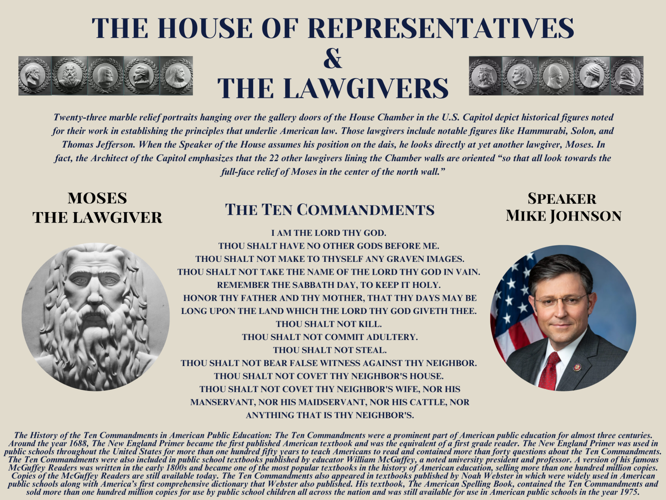
First, every sample poster developed for Louisiana classrooms (including the one with a photo of House Speaker Mike Johnson) uses the King James translation of the Bible. English language learners (including children born in the US to English-speaking parents) have enough trouble with the crazy rules of the language (like the silent ‘B’ in the words ‘comb’ and ‘tomb’–which don’t rhyme though they look like they should). All the Old English ‘Thee’s’ and ‘Thou’s’ and ‘Thy’s’ and ‘Shalt’s’ in the text will only make a difficult language even harder to learn.

Second, posting the Ten Commandments will not serve the political agenda of those who passed the law. Do we really want students to learn the Ten Commandments and then use those standards to evaluate the behavior of their representatives, senators and president? No other Gods? No adultery? No graven images? No false testimony or rumor-mongering? What students will REALLY learn is the meaning of the word ‘hypocrite.’ Rather than creating better-behaved, more moral citizens, the poster will create a generation of cynics who watch adults in power break the very rules posted on the wall for their own agendas.

Come to think of it, maybe posting the Ten Commandments in every Louisiana classroom IS a good idea. Every student could memorize them, then attend a Town Hall meeting with their Louisiana Representatives. There, they could recite all ten, then ask their Representative the question: “Do you think that someone who has broken one or more of these commands should be elected to public office?”

I would love to hear the answer from one particular Representative from Louisiana’s 4th District.

Living Woke – Week 3

Psalm 78 is a Jewish History curriculum for grades K-12. It is written by Asaph to parents who are reminded of God’s mandate that they tell the stories of the past to their children so that the next generation will learn and subsequently pass along the stories to their children.

The goal of the history lesson is two-fold: first, to ensure that each generation will understand God’s role in their history and put their hope in God (vs.6-7) and second, to avoid repeating the mistakes of the past. (vs. 8). The rest of the Psalm is account after account of ancestral sin and rebellion against God. The ancestors are not models of virtue, faith or courage. They are presented as ungrateful whiners and faithless idolaters. Despite God’s grace, forbearance and provision, the people keep turning away from God to lawlessness..

THAT is the honest truth. Instead of offering a litany of heroic battles and iconic personalities, Asaph reminds his parent/teachers that those who fail to known the past and learn from it are bound to repeat it. This is hard history for a better future.

Right now, there is a battle over the stories we tell our children. Some are demanding that we tell the truth, the whole truth and nothing but the truth. And the truth is hard–the American apartheid, the forced removal of indigenous peoples from their lands and the slaughter of those who resisted, the generational enslavement of Africans, the lynching trees and the systemic discrimination and disenfranchisement of minorities. Christian author, Jim Wallis, has identified racism and white supremacy supported through Christian Scriptures and manifest destiny as “America’s Original Sin.”

But there has been backlash to all the truth-telling. Many others want to silence the hard history and erase the memory of those who challenged the status quo. They prefer the patriotic stories of the past–the stories of American exceptionalism and American superiority and American glory. Thanks to an Executive Order signed on January 29, 2025, entitled, “Ending Radical Indoctrination in K-12 Schooling,” the hard truths of American history are being whitewashed. The president calls the efforts to include the darker parts of our history “anti-American, subversive, harmful and false,” and demands instead that schools devote themselves to “patriotic education” that will “instill a patriotic admiration for our incredible Nation.” A “Patriotic education” is defined in the following way:
(i) an accurate, honest, unifying, inspiring, and ennobling characterization of America’s founding and foundational principles;
(ii) a clear examination of how the United States has admirably grown closer to its noble principles throughout its history;
(iii) the concept that commitment to America’s aspirations is beneficial and justified; and
(iv) the concept that celebration of America’s greatness and history is proper.

While all that has a ring of noble intent, the ultimate goal is to stifle critical analysis and silence honest assessment of our past.. Embedded in the Executive Order is the elimination of ‘‘Discriminatory equity ideology’” (code for Diversity, Equity and Inclusion and Critical Race Theory.) As a result, we are literally watching history disappear.

Last fall, my wife and I followed a portion of the Civil Rights trail, starting in Atlanta, Georgia, traveling to Montgomery, Alabama, with a day trip to Selma. The trip was filled with hard history. On the return trip to Atlanta, we spent several hours at the Tuskegee Airmen National Historic Site. It was a sacred place of endurance and resilience, of struggle and strength. Legalized segregation was used to keep them in the shadows, but it could not keep them from shining. The Tuskegee Airfield is now a National Park Service museum campus that tells their stories.

But despite their accomplishments and the honor that has been given to these persevering pilots and mechanics, the Department of Defense began removing all references to the Tuskegee Airmen from its web site on March 7. Also removed were pages dedicated to Jackie Robinson and the Navajo Code Talkers. It was all a part of complying with the Executive Order that required the removal of anything that seemed to promote Diversity, Equity and Inclusion (DEI). Thankfully, due to the outcry of thousands of veterans, the Pentagon has returned some–but not all–of the pages and images.

Our nation has a long history of progress toward the ideal of “justice for all” followed by periods of backlash and regression. We are in a time of regression. But those whose eyes are opened must not give up or give in. We must keep telling the truth about our past and tell the stories of those who overcame adversity so that our children and their children will learn of God’s ways and renounce the sins of their ancestors. The future depends on it.

Poverty and Segregation Kill

According the most recent statistics compiled by the Chicago Health Atlas, where you live and what you look like makes a difference in your life expectancy. If you live downtown, you are likely to live to the ripe old age of 88. But if you live in West Garfield Park, you’ll be lucky if you live to celebrate your 64th birthday. That’s a gap of 25 years!

Sadly, the life-expectancy gap can be found in most large cities. A pre-pandemic study of the 500 largest cities in the US by the Department of Public Health at NYU school of Medicine revealed similar large gaps in Washington DC, New York City, New Orleans and Buffalo. And the gap is most evident between Black and non-Black residents. In Chicago, the gap is currently 11 years.

So what’s the cause? Before you say, “Gun Violence!”, the largest contributor to the gap is actually chronic disease, which cuts off 4.7 years of life. Diseases such as diabetes and heart disease are the main killers. Dr. Simbo Ige, Chicago’s public health commissioner, isn’t surprised by the link between where a person lives and health outcomes. Maps of Chicago’s household income, demographics, unemployment, infant mortality, and food access consistently overlap with the life-expectancy map. (See the Chicago Health Atlas for access to dozens of maps related to health and wellness.) For the record, gun violence is also a contributing factor for shortened life-expectancy, but it is not enough to explain the 25-year gap between the loop and West Garfield Park. In poor, segregated communities of color, there is less income, less access to medical care, fewer job opportunities, and fewer healthy food options. As a result, people in those communities die younger.

Why should we care about the life-expectancy gap? God’s vision of “shalom” articulated by the prophet Isaiah includes a vision of a complete elimination of infant morality and extended life-expectancy. (See Isaiah 65:20) We often point to individual behaviors as the determinants of health and life-expectancy, but when we look at the data, it goes beyond whether a person choses to eat fruits and vegetables or doesn’t. We need to ask deeper questions about why the maps clearly overlap? And we need to talk about root causes of poverty and segregation and the social determinants of health.

The bottom line is that pre-mature death is preventable, but do we have the social and political will? According to Dr. Ige, it takes a long term commitment. “”Reversing these trends will require consistent, long-term commitment to increase access and uptake of health protective behaviors and resources,” she told Axios. In an interview with the Chicago Sun-Times, she added, “The challenge here is the failure of societal attention for those who are most impacted. There is a zero-sum mindset, like if we try and put additional resources and some support in communities that are more impacted, everybody else feels like it is taking something away from them.”

Unfortunately, reducing the life-expectancy gap also takes resources (ie funding). Since 2022, the city of Chicago has poured resources into long-neglected communities, and it is making a difference. But much of the funding came from Federal pandemic-era programs that have dried up. Proposed cuts to Medicaid and nutrition programs will only make reducing the life-expectancy gap challenging.

When Philip went to the Samaritan city, his proclamation and works of healing brought great joy to the city (Acts 8:5-8). We are called to be bearers of light and life wherever we go. Every act of love and mercy–no matter how small–is life-giving. Even a cup of water given in Jesus’s name makes a difference. Go, make a difference.